Cells & molecules
Cell membrane
Cell biology · Fluid mosaic
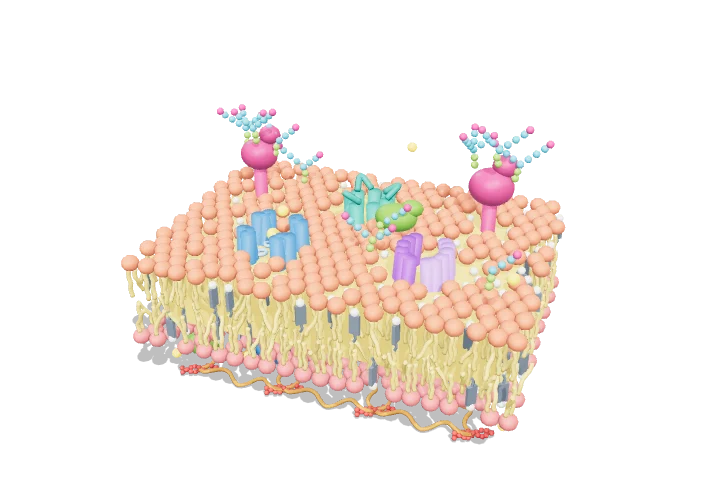 Open the interactive 3D model →
If a cell’s skin is only two molecules thick, how does it keep the cell’s insides in?
Every cell is wrapped in a membrane made of fatty molecules arranged in two layers, with their water-loving heads facing out and their oily tails tucked inside. The oily middle stops most charged and water-loving things from getting through. Proteins sitting in the membrane act as gates, pumps and antennas that control what goes in and out.
The plasma membrane is a fluid phospholipid bilayer in which proteins, cholesterol and glycolipids move laterally — the fluid mosaic model. The bilayer blocks ions and most polar molecules, so channels, carriers and pumps control what crosses, while receptors and the sugar-coated glycocalyx let the cell sense and be recognised by its surroundings.
Key facts
- Bilayer thickness
- ≈ 4–5 nm; hydrophobic core ≈ 3 nm
- Lipid lateral diffusion
- D ≈ 1 µm²/s — about 2 µm travelled per second
- Lipid flip-flop (unassisted)
- Hours to days or longer; flippases speed it
- Protein content
- ≈ 50% of plasma-membrane mass (≈ 1 protein per 50–100 lipids)
- Cholesterol
- Up to ≈ 1 per phospholipid in animal plasma membranes
- Ion channel throughput
- ≈ 10⁶–10⁸ ions/s per open channel
Parts you can explore (10)
- Phospholipid bilayer
- Cholesterol
- Channel protein
- Ions
- Transporter
- Integral proteins
- Glycoproteins
- Glycolipids
- Peripheral proteins
- Cytoskeleton
In the 3D model
Rotate and take apart the model, follow a guided tour of what each part does and why it’s needed, change it with a live slider, and test yourself with a short quiz. Free, no sign-up.
OpenArc Models’ models are simplified teaching schematics. Terms · Privacy