Physics
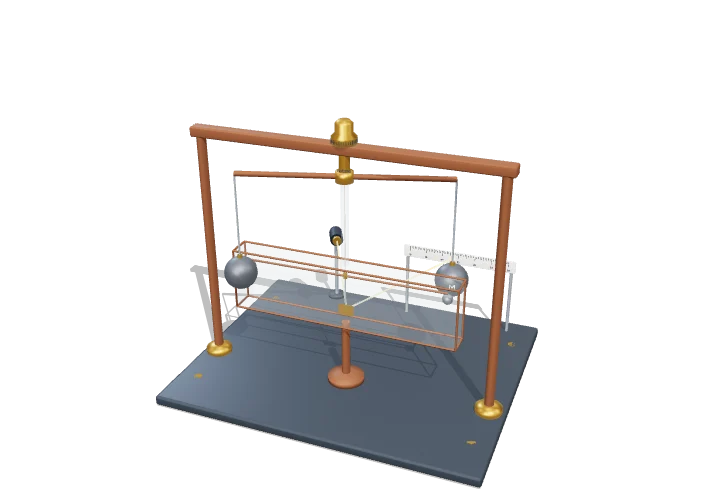
Cavendish torsion balance
Gravitation · Measuring G
 Open the interactive 3D model →
How can you weigh the whole Earth using two pairs of lead balls in a shed?
Everything with mass pulls on everything else, but between everyday objects the pull is incredibly weak. In 1798 Henry Cavendish hung two small lead balls from a thin wire and brought two big ones close. Measuring the tiny twist this caused told him how strong gravity is — and from that, how heavy the Earth is.
The torsion balance measures the gravitational attraction between laboratory masses by letting it twist a thin fibre, and calibrates the fibre from the free swing period. Combining the deflection angle with the period gives the gravitational constant G — and with it the mass and density of the Earth.
Key facts
- Gravitational constant (CODATA 2018)
- G = 6.674 30(15) × 10⁻¹¹ N m² kg⁻²
- Cavendish’s masses
- M = 158 kg, m = 0.73 kg
- Rod length
- 1.86 m (L = 0.93 m to each sphere)
- Free swing period
- ≈ 7 min
- Twist at equilibrium
- below 1 mrad (≈ 0.04°)
- Earth’s mean density (Cavendish, 1798)
- 5.48 g/cm³ (modern 5.51 g/cm³)
Parts you can explore (12)
- Support frame
- Torsion head
- Torsion fibre
- Torsion rod
- Small lead spheres
- Mirror
- Draught case
- Swing arm
- Large lead spheres
- Lamp
- Light beam
- Scale
In the 3D model
Rotate and take apart the model, follow a guided tour of what each part does and why it’s needed, change it with a live slider, and test yourself with a short quiz. Free, no sign-up.
Open Cavendish torsion balance in 3D →
OpenArc Models’ models are simplified teaching schematics. Terms · Privacy