Physics
Cathode-ray tube
Electromagnetism · Charged particles
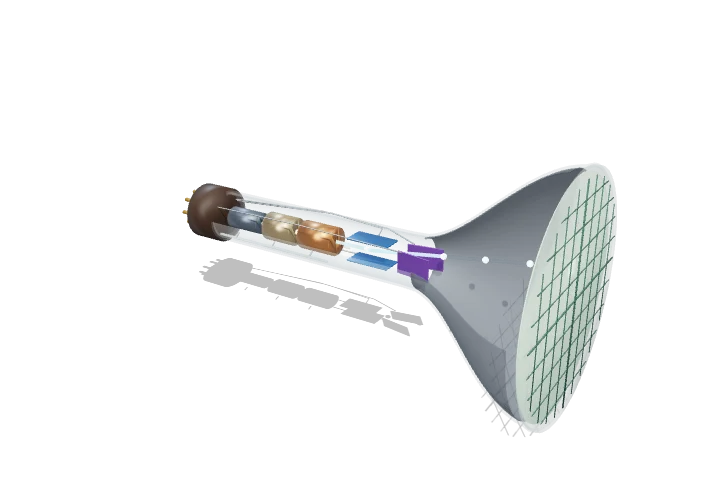 Open the interactive 3D model →
How did old TVs paint a picture on glass using particles too small to ever see?
A cathode-ray tube boils tiny charged particles called electrons off a hot metal surface and fires them down a glass tube with no air inside. Charged metal plates push the beam up or down. Where it hits the screen, a special coating glows.
A cathode-ray tube produces a narrow beam of electrons by thermionic emission and electrostatic acceleration, then steers it with electric (or magnetic) fields onto a phosphor screen. Because the deflection is proportional to the applied voltage, the same physics that let J. J. Thomson measure e/m in 1897 turned the CRT into the oscilloscope and the television picture tube.
Key facts
- Electron charge-to-mass ratio
- e/m = 1.759 × 10¹¹ C kg⁻¹
- Model accelerating voltage
- V_a = 1000 V → v ≈ 1.9 × 10⁷ m/s
- Model Y-plates
- l = 4 cm long, d = 2 cm apart, L = 17.3 cm to screen
- Deflection sensitivity (model)
- ≈ 0.17 mm per volt
- Cathode temperature (oxide)
- ≈ 1000–1100 K
- Tube vacuum
- ~10⁻⁶ mbar or better
Parts you can explore (13)
- Glass envelope
- Heater filament
- Cathode
- Control grid
- Focusing anode
- Accelerating anode
- Y-deflection plates
- X-deflection plates
- Electron beam
- Graphite coating
- Phosphor screen
- Screen spot
- Base and pins
In the 3D model
Rotate and take apart the model, follow a guided tour of what each part does and why it’s needed, change it with a live slider, and test yourself with a short quiz. Free, no sign-up.
OpenArc Models’ models are simplified teaching schematics. Terms · Privacy