Chemistry
Catalytic converter
Applied chemistry · Heterogeneous catalysis
 Open the interactive 3D model →
How do a few grams of platinum under a car clean poisonous exhaust — and why do they fail when cold?
A car engine makes three harmful gases: carbon monoxide, nitrogen oxides and unburnt fuel. The catalytic converter is a metal box holding a ceramic honeycomb coated with tiny specks of platinum, palladium and rhodium, which help these gases turn into harmless carbon dioxide, nitrogen and water. It only works once it is hot — above about 250 °C — so it does little in the first minute after a cold start.
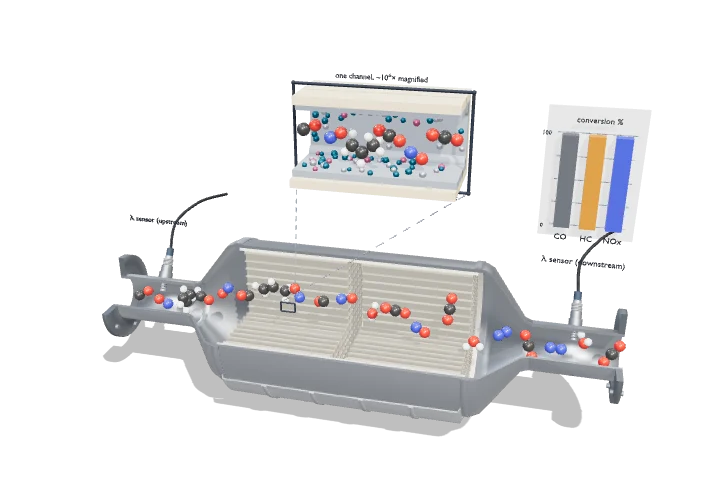
A three-way catalytic converter passes exhaust gas through a ceramic honeycomb coated with a porous oxide washcoat and nanoparticles of platinum, palladium and rhodium. Once hot, it simultaneously oxidises CO and hydrocarbons and reduces NOx to N₂, removing over 95% of all three when the engine runs at the stoichiometric air–fuel ratio.
Key facts
- Precious metal per car
- ≈ 1–7 g (Pd, Pt, Rh)
- Cell density
- 400–900 cells per in² (62–140 per cm²)
- Wall thickness
- 0.05–0.1 mm (2–4 mil)
- Light-off (50% conversion)
- ≈ 200–300 °C
- Operating temperature
- ≈ 400–800 °C
- Conversion when warm, λ = 1
- > 95% for CO, HC and NOx
Parts you can explore (13)
- Steel shell
- Inlet and outlet pipes
- Heat shield
- Intumescent mat
- Ceramic honeycomb monolith
- Upstream oxygen sensor
- Downstream oxygen sensor
- Washcoat (zoom inset)
- Zoom frame
- Pt/Pd/Rh nanoparticles
- Pollutants (CO, NOx, HC)
- Products (CO₂, N₂, H₂O)
- Conversion gauge
In the 3D model
Rotate and take apart the model, follow a guided tour of what each part does and why it’s needed, change it with a live slider, and test yourself with a short quiz. Free, no sign-up.
Open Catalytic converter in 3D →
OpenArc Models’ models are simplified teaching schematics. Terms · Privacy