Earth & space
Carbon cycle
Earth science · Biogeochemistry
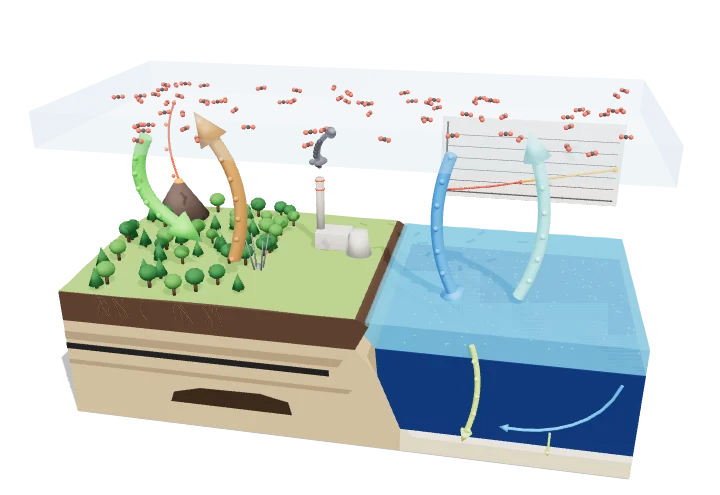 Open the interactive 3D model →
If plants soak up so much CO₂ every year, why does the amount in the air keep rising?
Carbon is always on the move: plants pull it out of the air, and living things, rotting leaves and the sea breathe it back out. These natural flows almost cancel out. Burning coal, oil and gas adds extra carbon that was buried for millions of years, and about half of it stays in the air.
The carbon cycle is the exchange of carbon among the atmosphere, land plants, soils, the ocean and rocks, through processes that range from photosynthesis (about 120 GtC each year on land) to rock weathering that works over millions of years. Burning fossil fuels and clearing land add about 11 GtC per year of carbon that had been locked away geologically, and because natural sinks absorb only about half of it, atmospheric CO₂ has risen from about 280 ppm before 1750 to over 420 ppm.
Key facts
- Atmospheric carbon (2023)
- ≈ 875 GtC (≈ 420 ppm CO₂)
- Conversion
- 1 ppm CO₂ ≈ 2.124 GtC ≈ 7.8 Gt CO₂
- Fossil CO₂ emissions (2013–2022 mean)
- ≈ 9.6 GtC/yr (≈ 35 Gt CO₂/yr)
- Land-use change emissions
- ≈ 1.2 GtC/yr
- Sinks (2013–2022)
- ocean ≈ 2.9, land ≈ 3.3 GtC/yr
- Atmospheric growth
- ≈ 5.2 GtC/yr (≈ 2.4 ppm/yr)
Parts you can explore (13)
- Atmosphere
- Land plants
- Soils
- Fossil fuels
- Combustion
- Surface ocean
- Deep ocean
- Marine sediments
- Photosynthesis
- Respiration and decay
- Ocean–atmosphere exchange
- Volcanic outgassing
- Atmospheric CO₂ trend
In the 3D model
Rotate and take apart the model, follow a guided tour of what each part does and why it’s needed, change it with a live slider, and test yourself with a short quiz. Free, no sign-up.
OpenArc Models’ models are simplified teaching schematics. Terms · Privacy