Chemistry
Carbon allotropes
Materials chemistry · Bonding & structure
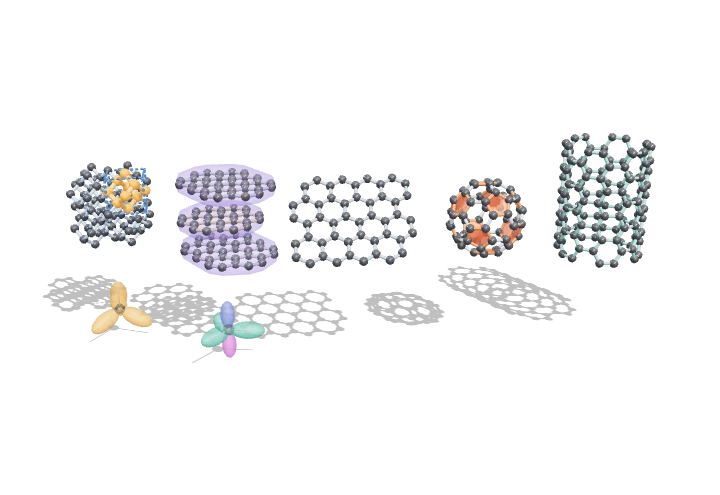 Open the interactive 3D model →
How can the same element make both the hardest gemstone and the soft grey stuff in a pencil?
Diamond, pencil graphite, graphene, football-shaped buckyballs and nanotubes are all made of nothing but carbon atoms. What differs is how each atom is joined to its neighbours: in diamond every atom grips four others in a rigid 3D frame, while in the others each atom grips three in flat sheets and shares its fourth electron across the sheet. That one difference makes diamond hard and insulating, and graphite soft, slippery and able to conduct electricity.
Carbon forms solids with radically different properties because it can bond through sp³ hybrids (diamond’s rigid tetrahedral network) or through sp² hybrids plus a delocalised π system (graphite, graphene, fullerenes and nanotubes). Geometry, hybridisation and electronic band structure are three views of the same bonding choice.
Key facts
- Diamond C–C
- 1.544 Å, 109.5°, cubic a = 3.567 Å
- Graphite/graphene C–C
- 1.42 Å, 120°, a = 2.46 Å
- Graphite interlayer spacing
- 3.35 Å (AB Bernal stacking)
- C₆₀ bond lengths
- 1.40 Å (6:6) and 1.45 Å (6:5)
- (6,6) nanotube diameter
- 8.14 Å (metallic armchair tube)
- Graphite → diamond
- ΔG° = +2.9 kJ mol⁻¹ at 298 K
Parts you can explore (11)
- Diamond network
- Adamantane cage
- Diamond unit cell
- sp³ hybrid orbitals
- Graphite layers
- Delocalised π clouds
- sp² + p orbitals
- Graphene sheet
- C₆₀ fullerene
- Pentagonal rings
- (6,6) nanotube
In the 3D model
Rotate and take apart the model, follow a guided tour of what each part does and why it’s needed, change it with a live slider, and test yourself with a short quiz. Free, no sign-up.
Open Carbon allotropes in 3D →
OpenArc Models’ models are simplified teaching schematics. Terms · Privacy