Fluids & heat
Car cooling system
Heat transfer · Liquid cooling circuit
 Open the interactive 3D model →
A car engine makes enough waste heat to warm a house — so why doesn’t it melt?
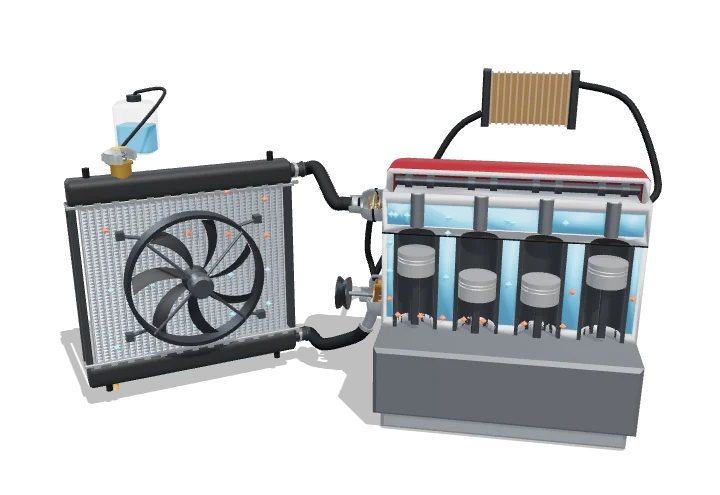
Burning fuel heats an engine’s metal far more than it can stand. A liquid called coolant is pumped through channels around the hot cylinders, soaks up the heat and carries it to the radiator at the front of the car. There, air rushing through thin metal fins carries the heat away, and the cooled liquid goes back for more.
A liquid cooling circuit carries the roughly one-third of fuel energy that leaks into an engine’s cylinder walls and head to a finned radiator, where it is passed to the air stream. A pump sets the flow, a wax thermostat holds the engine near 90–100 °C, and a pressure cap raises the boiling point so the system can run hot without boiling.
Key facts
- Heat to coolant
- ≈ 25–35 % of fuel energy (similar to brake power)
- Operating temperature
- ≈ 85–105 °C at the thermostat
- Thermostat
- starts to open ≈ 82–92 °C; fully open ≈ 10–12 K higher
- Cap pressure
- ≈ 0.9–1.4 bar gauge (13–20 psi)
- Coolant (50 % glycol)
- c ≈ 3.4–3.6 kJ/(kg·K); boils ≈ 107 °C at 1 atm, ≈ 125 °C under a 1 bar cap
- Radiator coolant drop
- typically ≈ 5–10 K at full flow
Parts you can explore (15)
- Radiator core
- Inlet tank
- Outlet tank
- Pressure cap
- Cooling fan
- Upper hose
- Lower hose
- Thermostat
- Water pump
- Engine water jacket
- Engine block and head
- Coolant flow
- Bypass hose
- Heater core
- Expansion tank
In the 3D model
Rotate and take apart the model, follow a guided tour of what each part does and why it’s needed, change it with a live slider, and test yourself with a short quiz. Free, no sign-up.
Open Car cooling system in 3D →
OpenArc Models’ models are simplified teaching schematics. Terms · Privacy