Electromagnetism & electronics
Capacitor
Electricity · Capacitance
 Open the interactive 3D model →
How can a camera flash store enough energy to light a room for an instant, then refill in seconds?
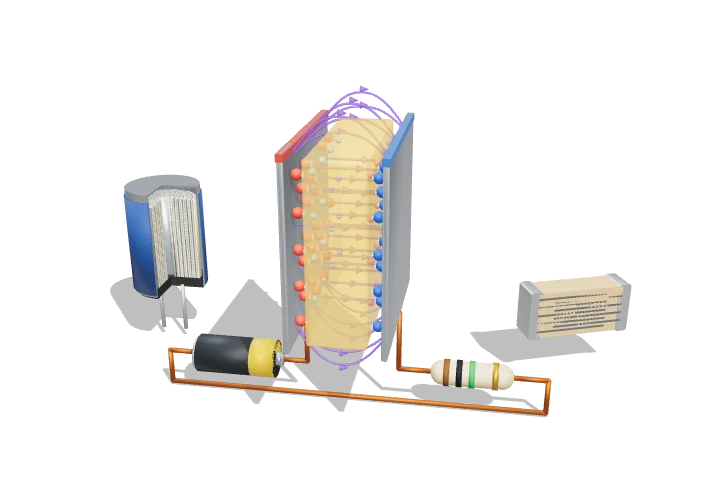
A capacitor is two metal plates very close together but not touching. A battery pulls electrons off one plate and pushes them onto the other, so one plate becomes positive and the other negative. That separated charge stores energy, which can be released very quickly when the plates are connected.
A capacitor stores equal and opposite charges on two conductors separated by an insulator, and with them energy in the electric field between them. Its capacitance C = Q/V grows with plate area and dielectric constant and falls with separation, and in a circuit with a resistor it charges and discharges exponentially with time constant RC.
Key facts
- Definition
- C = Q/V; 1 F = 1 C/V
- Parallel-plate formula
- C = κε₀A/d
- Shown example
- 10 cm × 10 cm, 1 mm gap: C₀ ≈ 88.5 pF
- Charge after one time constant
- 63.2% of final value
- Stored energy
- U = ½CV²
- Typical values
- pF (ceramic) to F (electrolytic, supercapacitor)
Parts you can explore (10)
- Positive plate
- Negative plate
- Free charges
- Electric field
- Dielectric
- Battery
- Resistor
- Connecting wires
- Electrolytic capacitor
- Multilayer ceramic capacitor
In the 3D model
Rotate and take apart the model, follow a guided tour of what each part does and why it’s needed, change it with a live slider, and test yourself with a short quiz. Free, no sign-up.
OpenArc Models’ models are simplified teaching schematics. Terms · Privacy