Power & energy
CANDU reactor
Nuclear power · Pressurised heavy-water reactor
 Open the interactive 3D model →
How can a nuclear reactor be refuelled while it is still running at full power?
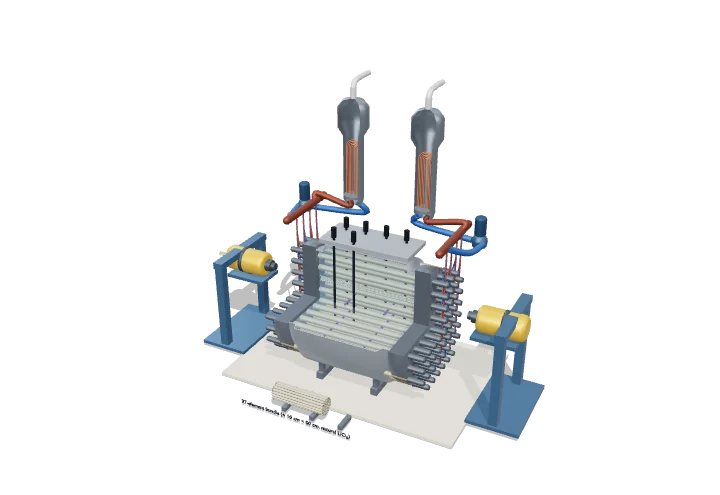
A CANDU reactor makes heat by splitting uranium just as it comes from the ground, without the costly step of enriching it. It can do this because its fuel sits in a tank of heavy water, a special water that wastes very few of the tiny particles (neutrons) that keep the reaction going. Machines at both ends push fresh fuel in and used fuel out every day while the reactor keeps running.
The CANDU (CANada Deuterium Uranium) reactor uses heavy water as moderator and coolant, which absorbs so few neutrons that natural uranium can sustain a chain reaction. Its fuel sits in hundreds of horizontal pressure tubes running through a low-pressure calandria tank, so the reactor can be refuelled channel by channel while it runs at full power.
Key facts
- Fuel
- natural UO₂ (0.72% U-235), 37-element bundles
- Fuel channels (CANDU-6)
- 380, 12 bundles each, on a 286 mm square lattice
- Moderator
- ≈ 260 t D₂O at ≈ 70 °C, near atmospheric pressure
- Heat-transport coolant
- D₂O at ≈ 10 MPa, ≈ 266 °C in, ≈ 310 °C out
- Output (CANDU-6)
- ≈ 2064 MWt → ≈ 700 MWe gross
- Refuelling rate
- ≈ 2 channels (≈ 16 bundles) per full-power day
Parts you can explore (12)
- Calandria
- Heavy-water moderator
- Pressure tubes
- Fuel bundles
- Fuel bundle (37-element)
- End shields
- End fittings and feeders
- Heat transport pumps and headers
- Steam generators
- Shutdown systems
- Fuelling machine (west)
- Fuelling machine (east)
In the 3D model
Rotate and take apart the model, follow a guided tour of what each part does and why it’s needed, change it with a live slider, and test yourself with a short quiz. Free, no sign-up.
OpenArc Models’ models are simplified teaching schematics. Terms · Privacy