Mechanisms
Cam and follower
Kinematics · Motion programme
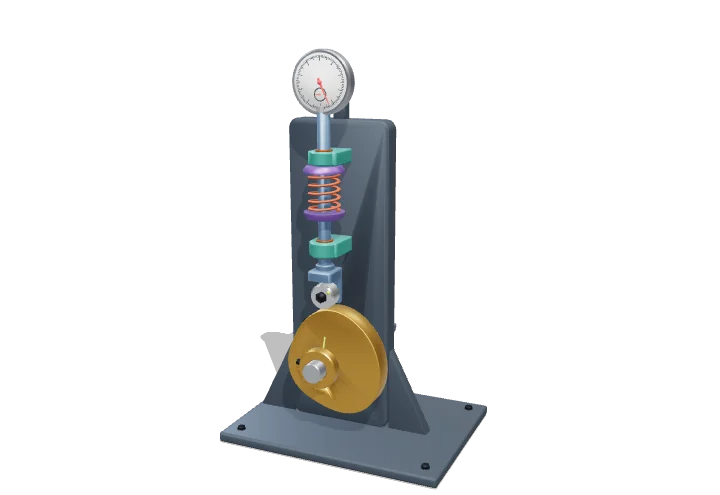 Open the interactive 3D model →
How does a car engine open each valve at exactly the right moment, thousands of times a minute?
A cam is a disc with a carefully shaped edge. As it turns, the bulge on its edge pushes a follower up, holds it, then lets it back down. The shape of the cam is the timetable of the motion.
A cam is a rotating profile whose varying radius drives a follower through a prescribed motion, so the cam’s shape is literally a stored program of displacement versus angle. Designers specify that program through its displacement, velocity, acceleration and jerk (SVAJ) curves, because acceleration sets the follower forces and the spring needed to keep contact.
Key facts
- Model motion program
- cycloidal rise 9 mm over 120°, dwell 60°, cycloidal return over 120°, dwell 60°
- Model follower
- roller Ø 9 mm; prime circle radius 18 mm (base circle 13.5 mm)
- Model peak pressure angle
- ≈ 21° (guideline ≤ ≈ 30° for translating roller followers)
- Car valve lift
- ≈ 8–13 mm
- Camshaft speed in 4-stroke engines
- ½ crankshaft speed
- Model float speed
- ≈ 1630 rpm (illustrative spring 40 N preload, 2 N/mm; 0.15 kg moving mass)
Parts you can explore (10)
- Cam
- Camshaft
- Shaft bearings
- Frame
- Guide
- Follower
- Follower roller
- Spring seats
- Return spring
- Dial indicator
In the 3D model
Rotate and take apart the model, follow a guided tour of what each part does and why it’s needed, change it with a live slider, and test yourself with a short quiz. Free, no sign-up.
OpenArc Models’ models are simplified teaching schematics. Terms · Privacy