Chemistry
Caffeine
Organic & medicinal chemistry · Purine alkaloid
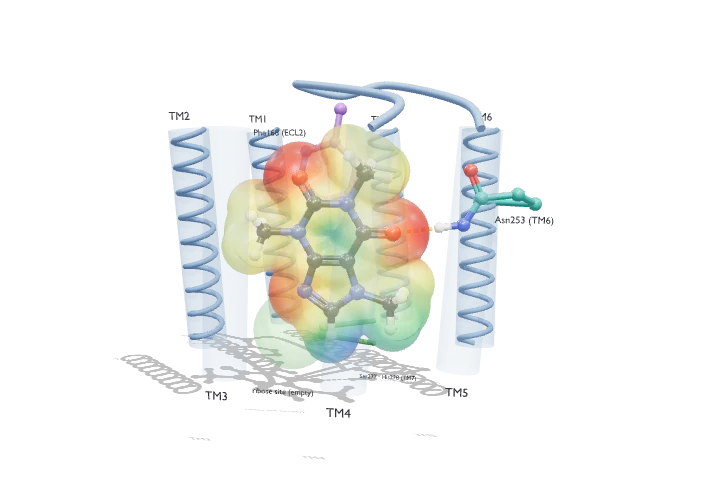 Open the interactive 3D model →
How does a morning coffee make you feel awake without giving your body any energy?
Caffeine is a small, flat molecule made of two joined rings of carbon and nitrogen, with two oxygens and three small methyl groups attached. Through the day your brain builds up a “getting tired” messenger called adenosine, which slows nerve cells down. Caffeine looks enough like adenosine to block its parking spot on nerve cells, but it cannot switch the signal on — so the tiredness message is muffled.
Caffeine is a small, planar purine alkaloid (1,3,7-trimethylxanthine) whose fused rings, two carbonyls and three N-methyl groups give it a flat shape and a distinctive pattern of partial charges. That shape lets it occupy the adenine pocket of adenosine receptors without activating them, so it acts as a competitive antagonist of the brain’s “fatigue” signal.
Key facts
- Formula / molar mass
- C₈H₁₀N₄O₂, 194.19 g/mol
- Ring system
- Purine (xanthine): 6-ring fused to 5-ring, all ring atoms sp² and coplanar
- Water solubility
- ≈ 2 g per 100 mL at 25 °C; much higher in hot water
- Affinity (human receptors)
- Kᵢ ≈ 2–3 µM at A₂A, ≈ 10–20 µM at A₁
- Plasma half-life (adults)
- ≈ 3–7 h (CYP1A2 metabolism)
- Typical intake
- ≈ 80–100 mg per cup of brewed coffee
Parts you can explore (12)
- Pyrimidinedione ring
- Imidazole ring
- Carbonyl groups
- Methyl groups
- Covalent bonds
- Fused ring plane
- Space-filling surface
- Electrostatic potential surface
- Receptor helices (A₂A)
- Phe168 π-stacking
- Asn253 hydrogen bond
- Empty ribose sub-pocket
In the 3D model
Rotate and take apart the model, follow a guided tour of what each part does and why it’s needed, change it with a live slider, and test yourself with a short quiz. Free, no sign-up.
OpenArc Models’ models are simplified teaching schematics. Terms · Privacy