Power & energy
Boiling water reactor
Nuclear power · Thermal power plant
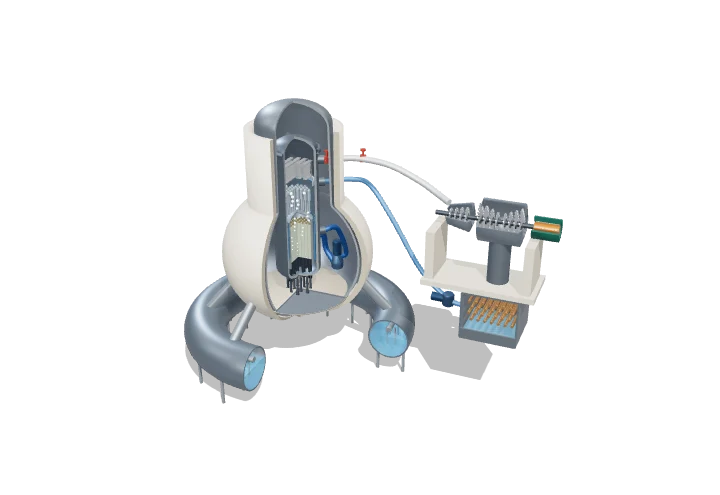 Open the interactive 3D model →
How can a nuclear reactor boil water like a kettle and send the steam straight to a turbine?
A boiling water reactor uses heat from splitting uranium atoms to boil water inside a huge steel vessel. The steam rushes straight to a turbine that spins a generator, then is cooled back into water and pumped back in. Pumping water through the core faster actually raises the power, because liquid water is what slows down the tiny particles (neutrons) that keep the reaction going.
A boiling water reactor lets its light-water coolant boil inside the reactor vessel at about 7 MPa, separates and dries the steam above the core, and sends it straight to the turbine in a single direct cycle. Power is adjusted mainly by changing recirculation flow through the jet pumps, which changes the amount of steam in the core and therefore its moderation.
Key facts
- Operating pressure
- ≈ 7.0–7.2 MPa
- Steam conditions
- saturated, ≈ 286 °C, < 0.1% moisture
- Core exit void fraction
- ≈ 70% by volume at full power
- Typical BWR/4 rating
- ≈ 3300 MWt → ≈ 1100 MWe (η ≈ 33%)
- Core flow
- ≈ 13 t/s (≈ 100 million lb/h)
- Fuel
- 560–760 channelled assemblies, UO₂ at ≈ 2–5% U-235
Parts you can explore (14)
- Mark I drywell
- Suppression pool (torus)
- Reactor pressure vessel
- Reactor core
- Control rods (bottom entry)
- Jet pumps
- Steam separators
- Steam dryer
- Recirculation loop
- Main steam line
- Turbine and generator
- Condenser
- Feedwater system
- Boiling coolant
In the 3D model
Rotate and take apart the model, follow a guided tour of what each part does and why it’s needed, change it with a live slider, and test yourself with a short quiz. Free, no sign-up.
Open Boiling water reactor in 3D →
OpenArc Models’ models are simplified teaching schematics. Terms · Privacy