Fluids & heat
Butterfly valve
Fluid systems · Quarter-turn valve
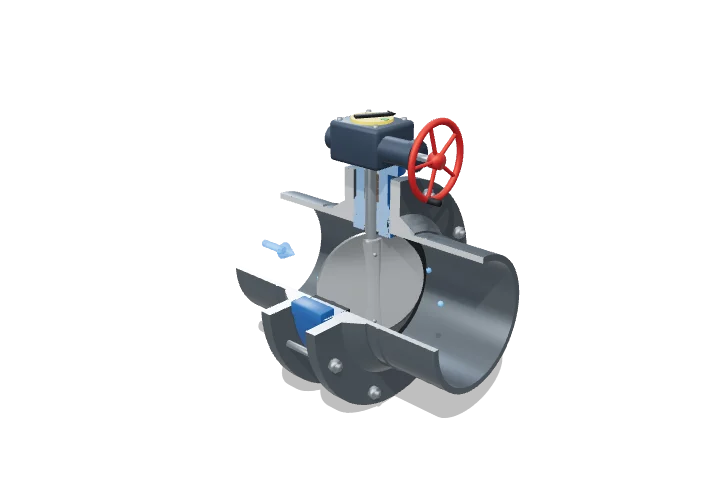 Open the interactive 3D model →
How can a flat disc no thicker than a book shut off a water main as wide as a dinner plate?
A butterfly valve is a metal disc on a rod, sitting right inside a pipe. Turn the rod a quarter of a turn and the disc swings from blocking the pipe completely to lying edge-on so water can pass. When it is shut, the edge of the disc presses into a rubber ring that seals the gap.
A butterfly valve controls flow with a disc that rotates a quarter turn on a stem, from sealing against an elastomer seat at 0° to edge-on at 90°. Its flow is described by the valve flow coefficient Cv (or Kv), and because the disc creates a high-velocity vena contracta followed by strong pressure recovery, throttling butterfly valves are particularly prone to cavitation and choked flow.
Key facts
- Operating travel
- 90° (quarter turn)
- Useful throttling range
- ≈ 20–70° open
- Liquid pressure-recovery factor F_L
- ≈ 0.55–0.7 near full open (low = cavitation-prone)
- Kv–Cv conversion
- Kv ≈ 0.865 Cv
- Resilient seat leakage
- Bubble-tight (no visible leakage) when new
- Model gearbox ratio
- 30:1 — 7.5 handwheel turns for 90°
Parts you can explore (12)
- Valve body
- Disc
- Stem
- Seat ring
- Stem bushings
- Packing gland
- Worm gearbox
- Handwheel
- Position indicator
- Pipe flanges
- Flange bolts & gaskets
- Flow
In the 3D model
Rotate and take apart the model, follow a guided tour of what each part does and why it’s needed, change it with a live slider, and test yourself with a short quiz. Free, no sign-up.
OpenArc Models’ models are simplified teaching schematics. Terms · Privacy