Plants & animals
Butterfly metamorphosis
Insects · Life cycle
 Open the interactive 3D model →
How does a crawling caterpillar rebuild itself into a butterfly inside a closed case?
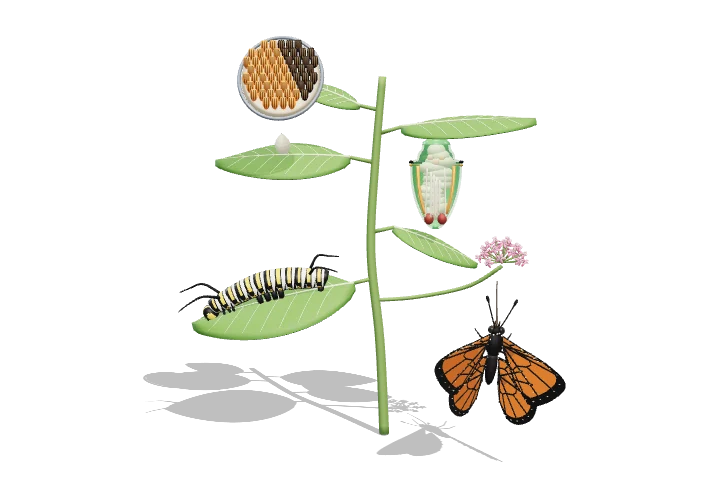
A monarch butterfly’s life has four stages: egg, caterpillar, chrysalis and adult. The caterpillar does nothing but eat and grow, shedding its skin as it gets bigger. Inside the chrysalis much of its body is broken down while small groups of cells it has carried all along grow into wings, legs, eyes and antennae.
Butterflies undergo complete metamorphosis: a feeding larva grows through several moults, then a pupa rebuilds the body into a winged, nectar-feeding adult. The switch is controlled by the hormones ecdysone and juvenile hormone, and the adult structures develop from imaginal discs set aside in the larva.
Key facts
- Species modelled
- Monarch, Danaus plexippus
- Egg
- ≈ 1.2 mm tall; hatches in ≈ 3–5 days
- Larva
- 5 instars over ≈ 9–14 days; final length ≈ 4.5 cm
- Pupa
- ≈ 8–15 days, temperature dependent
- Adult
- Wingspan ≈ 9–10 cm; lives weeks, or ≈ 8 months in the migratory generation
- Larval mass gain
- ≈ 2,000-fold from hatching to pupation
Parts you can explore (14)
- Host plant
- Egg
- Larval head
- Larva
- Prolegs and true legs
- Spiracles
- Chrysalis
- Cremaster
- Imaginal discs
- Adult body
- Wings
- Proboscis
- Antennae
- Wing scale inset
In the 3D model
Rotate and take apart the model, follow a guided tour of what each part does and why it’s needed, change it with a live slider, and test yourself with a short quiz. Free, no sign-up.
Open Butterfly metamorphosis in 3D →
OpenArc Models’ models are simplified teaching schematics. Terms · Privacy