Human body
Human brain
Anatomy · Central nervous system
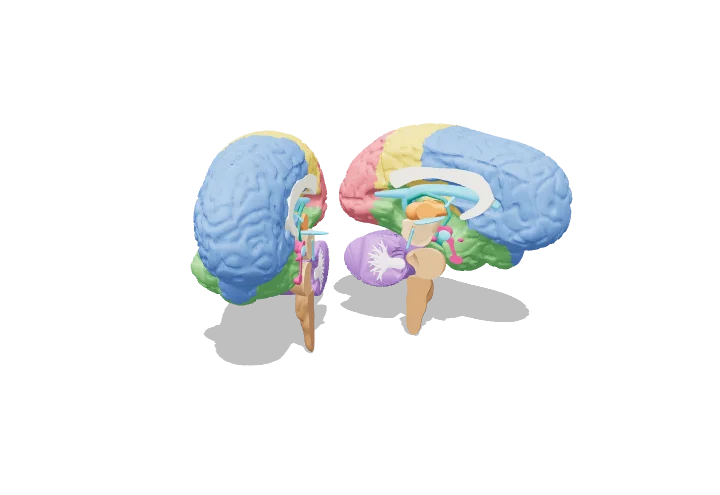 Open the interactive 3D model →
How does a 1.4 kg lump of tissue let you see, move, speak and remember?
Your brain is divided into regions that specialise in different jobs: some handle seeing or hearing, others plan movements or store memories. A thick wrinkled outer layer, the cerebral cortex, does most of the thinking, while deeper parts relay messages, control hunger and body temperature, and keep you breathing. All the regions are wired together so they can work as one.
The brain consists of two folded cerebral hemispheres, each divided into frontal, parietal, temporal and occipital lobes, joined by the corpus callosum and sitting on the diencephalon (thalamus and hypothalamus), brainstem and cerebellum. A midsagittal section reveals the deep midline structures and the CSF-filled ventricular system that runs through them.
Key facts
- Mass (adult)
- ≈ 1.2–1.4 kg, about 2% of body mass
- Neurons
- ≈ 86 billion (≈ 16 billion in the cortex, ≈ 69 billion in the cerebellum)
- Energy use
- ≈ 20% of resting O₂ consumption, ≈ 20 W
- Cortical thickness
- ≈ 2–4 mm
- Cortical surface area
- ≈ 0.18–0.24 m² for both hemispheres, about two-thirds buried in sulci
- CSF production
- ≈ 500 mL per day; ≈ 150 mL present at any time
Parts you can explore (13)
- Frontal lobe
- Parietal lobe
- Temporal lobe
- Occipital lobe
- Cerebellum
- Midbrain
- Pons
- Medulla oblongata
- Corpus callosum
- Thalamus
- Hypothalamus
- Hippocampus
- Ventricles
In the 3D model
Rotate and take apart the model, follow a guided tour of what each part does and why it’s needed, change it with a live slider, and test yourself with a short quiz. Free, no sign-up.
OpenArc Models’ models are simplified teaching schematics. Terms · Privacy