Human body
Bone & osteon
Anatomy · Skeletal system · Histology
 Open the interactive 3D model →
How can a thighbone light enough to run on carry several times your body weight with every stride?
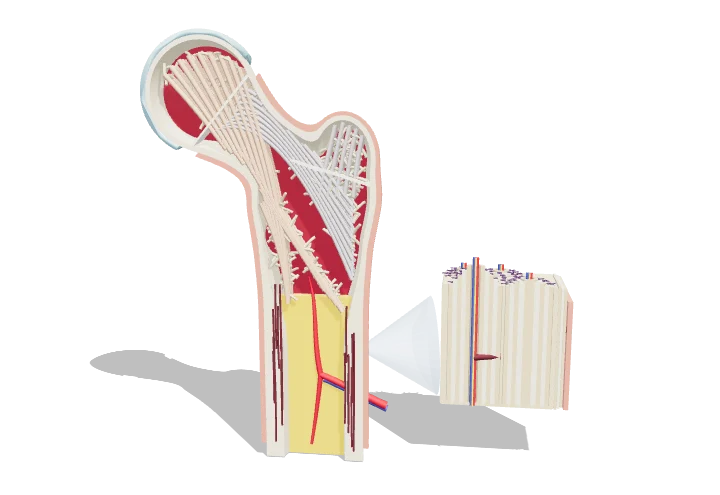
Bone is not solid rock: it is living tissue made of tough protein fibres hardened with calcium minerals. The outside is a dense shell, while the ends are filled with a light honeycomb of struts lined up exactly along the directions the bone gets pushed and pulled. Living cells inside keep rebuilding it, adding bone where it is loaded and removing it where it is not.
Bone is a living composite of collagen and hydroxyapatite arranged as dense compact bone, built from cylindrical osteons, and porous spongy bone whose trabeculae align with the loads they carry. Cells embedded in and lining this matrix continually remodel it, so the skeleton adapts its architecture to mechanical demand.
Key facts
- Matrix composition (by mass)
- ≈ 60–70% mineral (hydroxyapatite), 20–30% organic (mostly type I collagen), ≈ 10% water
- Compact vs spongy
- ≈ 80% / 20% of skeletal mass
- Osteon diameter
- ≈ 150–250 µm; central canal ≈ 50 µm
- Lamella thickness
- ≈ 3–7 µm
- Adult remodelling rate
- ≈ 10% of the skeleton per year
- Hip contact force, walking
- ≈ 2.5–3× body weight
Parts you can explore (12)
- Compact bone
- Spongy bone (trabeculae)
- Red marrow
- Medullary cavity (yellow marrow)
- Articular cartilage
- Periosteum
- Epiphyseal line
- Osteons (inset)
- Haversian canals & vessels
- Lacunae & canaliculi
- Volkmann's canals
- Nutrient artery
In the 3D model
Rotate and take apart the model, follow a guided tour of what each part does and why it’s needed, change it with a live slider, and test yourself with a short quiz. Free, no sign-up.
OpenArc Models’ models are simplified teaching schematics. Terms · Privacy