Electromagnetism & electronics
Brushless outrunner motor
Electromagnetism · Motors
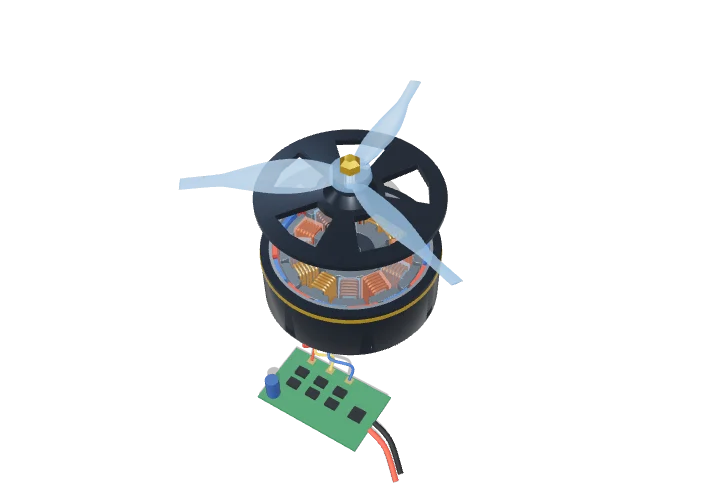 Open the interactive 3D model →
How does a drone motor spin at 30,000 rpm with no brushes and nothing touching inside?
In this motor a ring of magnets on a spinning cup surrounds a star of copper coils that stays still. A small circuit board switches electric current through the coils in turn, so they keep becoming magnets just ahead of the spinning ones and pull them round. Nothing rubs, so it can spin very fast for a long time.
A brushless DC outrunner has stationary three-phase windings on a toothed stator and a rotating bell lined with permanent magnets. An electronic speed controller uses rotor-position information to switch the phase currents in six steps per electrical cycle, so the stator field always leads the magnets and produces continuous torque.
Key facts
- Configuration
- 12N14P: 12 stator teeth, 14 magnet poles (7 pole pairs)
- Typical drone motor
- “2207”: 22 mm stator diameter, 7 mm stack height
- Kv rating
- ≈ 1,700–2,700 rpm V⁻¹ for 5-inch racing drones
- Speed on 4S (14.8 V)
- ≈ 25,000–35,000 rpm
- Commutation
- 6 steps per electrical cycle, 42 per revolution
- Efficiency
- ≈ 80–90 % at moderate load
Parts you can explore (11)
- Stator core
- Stator windings
- Permanent magnets
- Rotor bell
- Bell cap
- Propeller
- Shaft and bearings
- Base mount
- Hall sensors
- ESC board
- Phase leads
In the 3D model
Rotate and take apart the model, follow a guided tour of what each part does and why it’s needed, change it with a live slider, and test yourself with a short quiz. Free, no sign-up.
Open Brushless outrunner motor in 3D →
OpenArc Models’ models are simplified teaching schematics. Terms · Privacy