Astronomy & space
Black hole
Astrophysics · General relativity
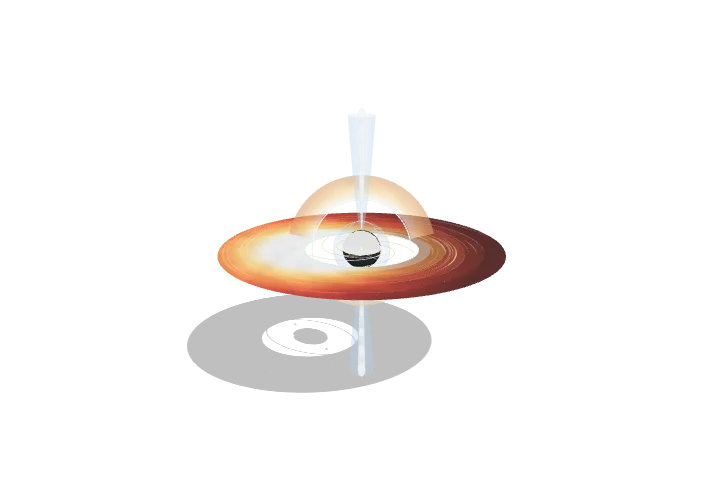 Open the interactive 3D model →
If nothing can escape a black hole, not even light, how have we taken pictures of two of them?
A black hole is a place where so much mass is squeezed into so small a space that its gravity lets nothing escape, not even light. We cannot see the hole itself, but gas swirling around it gets incredibly hot and glows brightly before it falls in. Gravity bends that light around the hole, so telescopes see a bright ring around a dark shadow.
A black hole is a region of spacetime where gravity is so strong that nothing can escape from inside its event horizon, whose radius for a non-rotating hole is r_s = 2GM/c². Gas falling toward it forms a hot, rapidly orbiting accretion disk whose light is bent, beamed and redshifted by relativity, making accreting black holes among the brightest objects in the Universe.
Key facts
- Schwarzschild radius
- r_s = 2GM/c² ≈ 2.95 km × (M/M☉)
- Photon sphere
- 1.5 r_s
- Innermost stable circular orbit
- 3 r_s (non-rotating hole)
- Apparent shadow radius
- √27/2 r_s ≈ 2.6 r_s
- Sagittarius A*
- ≈ 4.3 × 10⁶ M☉, r_s ≈ 1.3 × 10⁷ km
- M87*
- ≈ 6.5 × 10⁹ M☉, r_s ≈ 130 AU
Parts you can explore (9)
- Event horizon
- Singularity
- Schwarzschild radius marker
- Photon sphere
- Innermost stable circular orbit
- Accretion disk
- Plunging gas
- Gravitational lensing ring
- Relativistic jets
In the 3D model
Rotate and take apart the model, follow a guided tour of what each part does and why it’s needed, change it with a live slider, and test yourself with a short quiz. Free, no sign-up.
OpenArc Models’ models are simplified teaching schematics. Terms · Privacy