Plants & animals
Bird wing
Vertebrates · Bird flight
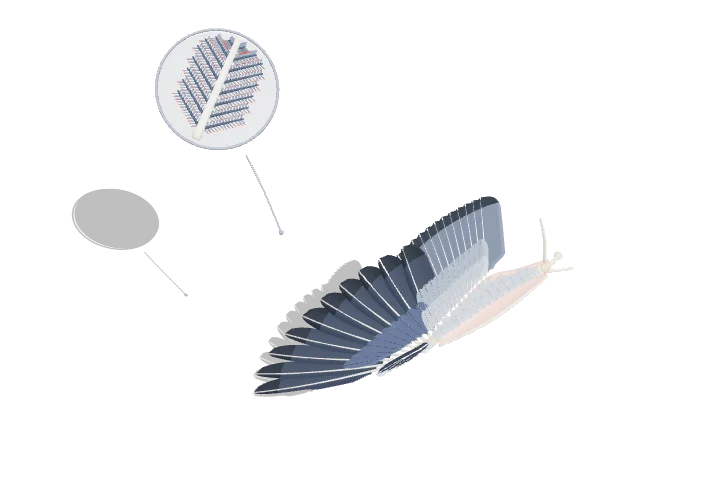 Open the interactive 3D model →
A bird’s wing is really an arm and a hand — so how does it turn into something that flies?
Inside every bird wing are the same bones as your arm and hand, but light, hollow and partly fused together. Long flight feathers attached to these bones overlap to make a smooth, curved surface that lifts the bird. On each downbeat the feathers close into a solid sheet; on the way up they twist open to let air through.
A bird wing is a modified forelimb in which a light, partly fused skeleton supports a cambered airfoil made of overlapping flight feathers. Flapping turns the hand into a propeller: the closed downstroke produces lift and thrust, and the flexed, slotted upstroke recovers the wing at low cost.
Key facts
- Primaries
- Usually 10, attached to the hand (9–12 across birds)
- Secondaries
- ≈ 11–12 in pigeons; 6 in hummingbirds to ~40 in albatrosses
- Pigeon wingbeat
- ≈ 5–7 Hz cruising; ≈ 9–10 Hz at take-off
- Pigeon wing loading
- ≈ 50–60 N m⁻² (0.35 kg on ≈ 0.065 m² of wing)
- Flight muscles
- Pectoralis ≈ 15–20% of body mass; supracoracoideus ≈ 2–3%
- Feather material
- β-keratin (corneous β-proteins)
Parts you can explore (10)
- Humerus
- Radius and ulna
- Carpometacarpus and digits
- Shoulder girdle
- Primary feathers
- Secondary feathers
- Coverts
- Alula
- Skin and patagium
- Feather structure
In the 3D model
Rotate and take apart the model, follow a guided tour of what each part does and why it’s needed, change it with a live slider, and test yourself with a short quiz. Free, no sign-up.
OpenArc Models’ models are simplified teaching schematics. Terms · Privacy