Power & energy
Biogas digester
Renewable energy · Anaerobic digestion
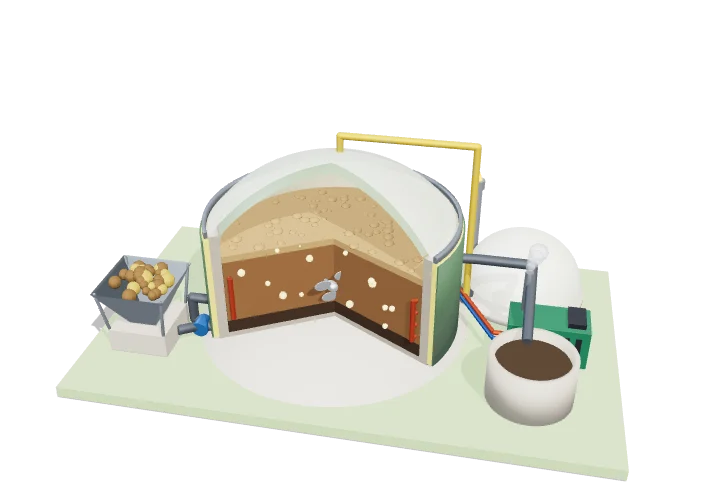 Open the interactive 3D model →
How can a tank of cow manure keep a farm's lights on?
Inside a sealed tank kept about as warm as your body, tiny microbes eat manure and food scraps without any air. As they feed they give off biogas, a burnable gas that is mostly methane, the same fuel used in many gas cookers. An engine burns the gas to make electricity and hot water, and the leftover sludge becomes fertiliser.
An anaerobic digester is a sealed, warmed and stirred tank in which communities of bacteria and archaea break down organic waste without oxygen, producing biogas — mostly methane and carbon dioxide — and a nutrient-rich digestate. The biogas is stored under a membrane and burned in a combined-heat-and-power engine, turning manure and food waste into electricity, heat and fertiliser.
Key facts
- Biogas composition
- ≈ 50–70% CH₄, 30–50% CO₂, traces of H₂S, NH₃, H₂O
- Energy content
- ≈ 6 kWh m⁻³ (≈ 21–23 MJ m⁻³) at 60% CH₄
- Mesophilic range
- ≈ 30–40 °C, optimum ≈ 35–38 °C
- Thermophilic range
- ≈ 50–60 °C, optimum ≈ 55 °C
- Hydraulic retention time
- ≈ 20–40 days (mesophilic), ≈ 10–20 days (thermophilic)
- Volumetric gas production
- ≈ 0.5–2 m³ biogas per m³ digester per day
Parts you can explore (11)
- Digester tank
- Sludge
- Heating coils
- Mixer
- Gas dome
- Biogas bubbles
- Feedstock inlet
- Digestate outlet
- Gas pipeline
- Gas holder
- CHP generator
In the 3D model
Rotate and take apart the model, follow a guided tour of what each part does and why it’s needed, change it with a live slider, and test yourself with a short quiz. Free, no sign-up.
OpenArc Models’ models are simplified teaching schematics. Terms · Privacy