Fluids & heat
Bimetallic thermostat
Thermal expansion · Temperature control
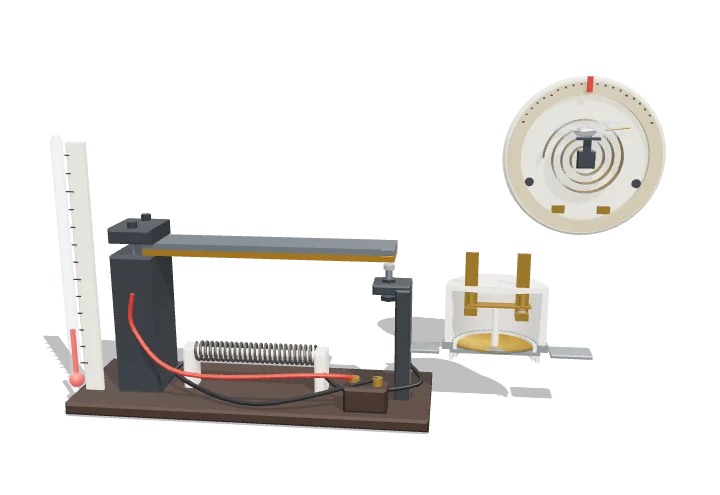 Open the interactive 3D model →
How does a kettle know to switch itself off — without any electronics at all?
Most metals grow slightly when they warm up, but some grow much more than others. Glue a strip of a stretchy-when-hot metal to one that hardly grows, and when it warms up the pair has to bend. That bending can push electrical contacts apart, switching a heater off at just the right temperature.
A bimetallic element bonds two metals with different thermal expansion coefficients, so any temperature change forces it to bend by an amount proportional to the temperature change. Thermostats turn that bending into switching — gradually in a strip, suddenly in a dished snap disc, and as a rotation in the coiled element of a wall thermostat.
Key facts
- Brass vs Invar expansion
- ≈ 19 vs ≈ 1.2 × 10⁻⁶ K⁻¹
- Curvature (equal layers)
- κ = 3Δα·ΔT / (2h)
- 50 mm × 1 mm brass/Invar strip
- tip moves ≈ 0.03 mm per kelvin
- Snap-disc differential
- typically ≈ 10–30 K between trip and reset
- Wall-thermostat differential
- ≈ 0.5–1 K
Parts you can explore (13)
- Brass layer
- Invar layer
- Strip clamp
- Electrical contacts
- Heater element
- Wiring
- Snap-disc housing
- Bimetal snap disc
- Snap-disc switch
- Wall thermostat base
- Bimetal coil
- Mercury switch
- Thermometer
In the 3D model
Rotate and take apart the model, follow a guided tour of what each part does and why it’s needed, change it with a live slider, and test yourself with a short quiz. Free, no sign-up.
Open Bimetallic thermostat in 3D →
OpenArc Models’ models are simplified teaching schematics. Terms · Privacy