Mechanisms
Road bicycle drivetrain
Mechanisms · Chain drive and gearing
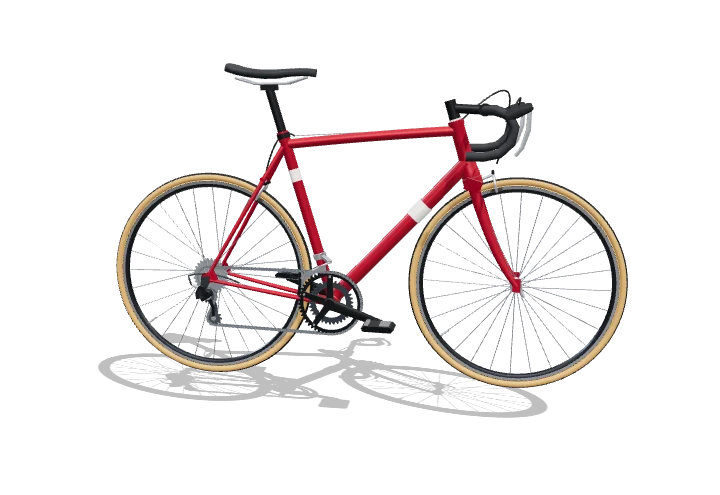 Open the interactive 3D model →
Why is it easy to pedal up a hill in one gear but nearly impossible in another?
When you pedal, a chain carries your effort from the big toothed rings at the pedals to a small toothed cog on the back wheel. Swapping to a bigger back cog makes each pedal turn move the bike a shorter distance, which feels easier. Derailleurs are the little arms that push the moving chain from one cog to another.
A bicycle drivetrain is a chain drive whose speed ratio equals chainring teeth divided by cog teeth, so 2 chainrings and 11 cogs give 22 ratios between about 1.2 and 4.5. Derailleurs change gear by pushing the moving chain sideways onto another sprocket, and a sprung cage takes up the change in chain length so the fixed loop of links stays taut.
Key facts
- Chain pitch
- 12.7 mm (½ in) per link
- Gearing shown
- 50/34 chainrings × 11–28 cassette (22 combinations)
- Ratio range
- 1.21 (34×28) to 4.55 (50×11)
- Speed at 90 rpm
- ≈ 15 km/h (34×28) to ≈ 52 km/h (50×11)
- Wheel circumference
- ≈ 2.105 m (700×25c)
- Chain-drive efficiency
- ≈ 95–98% when clean and lubricated
Parts you can explore (12)
- Frame
- Front wheel
- Rear wheel
- Rear cassette
- Crankset
- Pedals
- Chain
- Rear derailleur
- Front derailleur
- Handlebar and stem
- Saddle and seatpost
- Brakes
In the 3D model
Rotate and take apart the model, follow a guided tour of what each part does and why it’s needed, change it with a live slider, and test yourself with a short quiz. Free, no sign-up.
Open Road bicycle drivetrain in 3D →
OpenArc Models’ models are simplified teaching schematics. Terms · Privacy