Chemistry
Benzene & aromaticity
Organic chemistry · Aromaticity
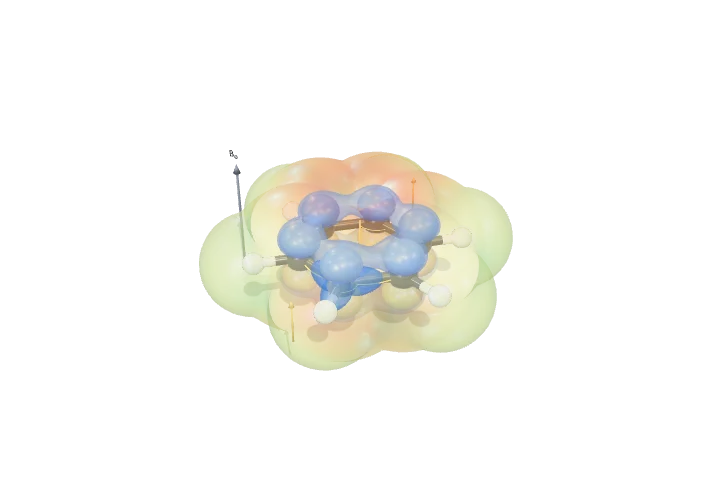 Open the interactive 3D model →
Benzene can be drawn with three double bonds — so why are all six of its bonds exactly the same length?
Benzene is a flat ring of six carbon atoms, each holding one hydrogen. Chemists can draw it with three double bonds in two different ways, but the real molecule is neither: six of its electrons are shared evenly around the whole ring. This shared ring of electrons makes benzene extra stable, a property called aromaticity.
Benzene is a planar hexagon of six sp² carbons whose six p orbitals overlap around the whole ring, so its six π electrons are delocalised rather than fixed in three double bonds. Delocalisation makes all C–C bonds equal (1.39 Å) and lowers the energy by about 150 kJ mol⁻¹ — the hallmark of aromaticity, captured by Hückel’s 4n + 2 rule.
Key facts
- C–C bond length
- 1.39 Å (all six equal; C–C single 1.54 Å, C=C 1.34 Å)
- C–H bond length
- 1.09 Å
- Bond angles
- 120° (regular hexagon, D₆h symmetry)
- π electrons
- 6 = 4n + 2 with n = 1
- Resonance (aromatic stabilisation) energy
- ≈ 150 kJ mol⁻¹ (from hydrogenation enthalpies)
- ¹H NMR shift
- δ ≈ 7.3 ppm (ring-current deshielding)
Parts you can explore (12)
- Carbon atoms
- Hydrogen atoms
- σ-bond framework
- Kekulé structure A
- Kekulé structure B
- p orbitals
- π cloud (above ring)
- π cloud (below ring)
- sp² hybrid orbitals
- Ring current (NMR)
- Bond-angle markers
- Electrostatic potential surface
In the 3D model
Rotate and take apart the model, follow a guided tour of what each part does and why it’s needed, change it with a live slider, and test yourself with a short quiz. Free, no sign-up.
Open Benzene & aromaticity in 3D →
OpenArc Models’ models are simplified teaching schematics. Terms · Privacy