Mechanisms
Belt drive
Power transmission · Speed ratio
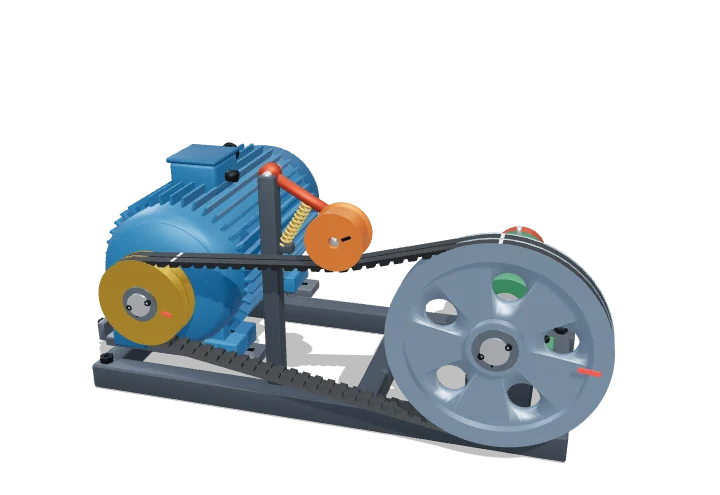 Open the interactive 3D model →
Why do so many machines use a rubber belt instead of connecting the motor straight to the job?
A belt drive passes the spin of a motor to another shaft using a rubber loop around two wheels called pulleys. The belt grips the pulleys by friction, so a small pulley can drive a big one more slowly but more strongly. The belt is cheap, quiet and soaks up jolts.
A belt drive transmits power between shafts by friction between a flexible belt and pulleys, with the speed ratio set by the pulley diameters. The torque it can carry is limited by the ratio of tight-side to slack-side tension, which grows exponentially with friction coefficient and wrap angle according to the capstan (Euler–Eytelwein) equation.
Key facts
- Speed ratio (model)
- d₂/d₁ = 225/100 = 2.25 (driven at 0.44×)
- Belt speed at 1450 rpm
- v = π × 0.1 m × 1450/60 ≈ 7.6 m/s
- Wrap on small pulley (model)
- ≈ 166° with the idler (162° without)
- Tension ratio limit
- T₁/T₂ = e^{fθ} (flat); V-belt f′ = f / sin(β/2)
- Efficiency
- ≈ 95–98% V-belt, ≈ 97–99% synchronous
- Elastic creep (friction belts)
- ≈ 0.5–2% speed loss
Parts you can explore (10)
- Driver pulley
- Driven pulley
- Belt
- Motor
- Tensioner
- Frame & shafts
- Pillow-block bearings
- Motor adjustment rails
- Taper-lock bushes
- Fasteners
In the 3D model
Rotate and take apart the model, follow a guided tour of what each part does and why it’s needed, change it with a live slider, and test yourself with a short quiz. Free, no sign-up.
OpenArc Models’ models are simplified teaching schematics. Terms · Privacy