Physics
Bar magnet field
Electromagnetism · Magnetic fields
 Open the interactive 3D model →
A magnet pulls on a paperclip without touching it — what fills the space in between?
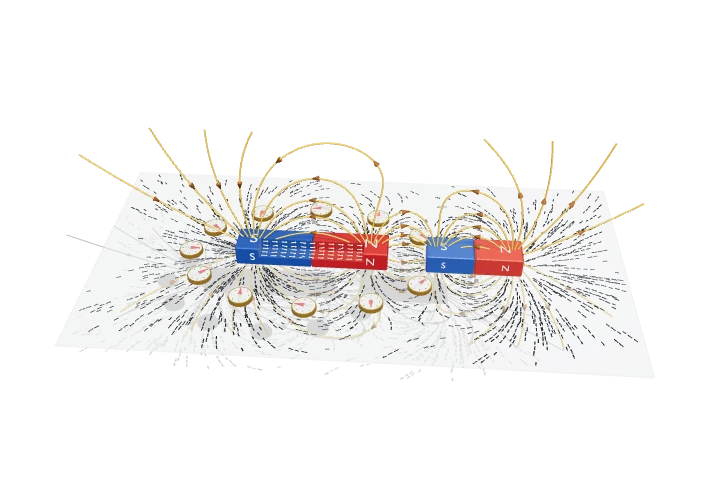
Every magnet is surrounded by an invisible magnetic field that pushes and pulls on other magnets and on iron. We can draw the field as lines that leave the north pole, loop around and go back in at the south pole. Iron filings and compass needles line up along those lines and make them visible.
A magnetised bar produces a magnetic field whose lines leave its north pole, curve around outside and return through the south pole, forming closed loops. Compasses and iron filings make the field visible because each becomes a small magnet that turns to line up with the local direction of B.
Key facts
- Field-line rule
- Outside: N → S; inside: S → N (closed loops)
- Far-field fall-off
- |B| ∝ 1/r³ (magnetic dipole)
- Earth’s surface field
- ≈ 25–65 µT
- Neodymium (NdFeB) remanence
- ≈ 1.0–1.4 T
- Ferrite (ceramic) remanence
- ≈ 0.2–0.45 T
- Model scale
- 1 unit ≈ 5 cm; field values relative
Parts you can explore (9)
- North pole
- South pole
- Magnetic domains
- Field lines
- Field direction arrows
- Acrylic sheet
- Iron filings
- Compasses
- Second magnet
In the 3D model
Rotate and take apart the model, follow a guided tour of what each part does and why it’s needed, change it with a live slider, and test yourself with a short quiz. Free, no sign-up.
OpenArc Models’ models are simplified teaching schematics. Terms · Privacy