Fluids & heat
Ball valve with pneumatic actuator
Fluid systems · Quarter-turn valve
 Open the interactive 3D model →
How can a ball with a hole through it shut off a gas pipeline in under a second?
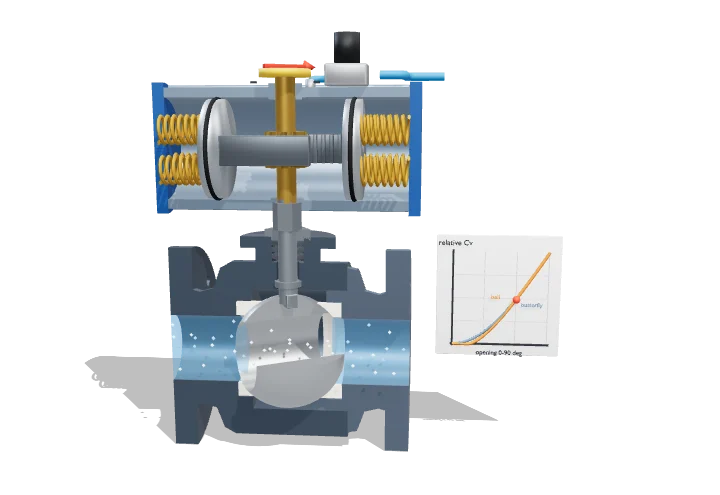
Inside a ball valve is a metal ball with a hole drilled straight through it. Turn it a quarter turn so the hole lines up with the pipe and fluid flows; turn it back so the solid side faces the pipe and the flow stops. On this valve, compressed air opens it and springs snap it shut if the air or power is lost.
A ball valve controls flow by rotating a bored sphere a quarter turn between two soft seats, so it opens and shuts quickly and seals tightly. Driven by a spring-return pneumatic actuator it becomes a fail-safe automated shut-off or control valve whose flow coefficient varies strongly and non-linearly with opening angle.
Key facts
- Travel
- 90° from shut to fully open
- Model size
- DN50 (2 in) full port: 50 mm bore, 84 mm ball
- Full-open Cv (2 in full port)
- typically 300–550 US gpm/psi^½
- Seat material
- PTFE / reinforced PTFE, ≈ −30 to 200 °C
- Actuator supply
- instrument air, typically 4–7 bar (5.5 bar common)
- Shut-off class
- soft-seated valves commonly reach ANSI/FCI 70-2 Class VI (bubble-tight)
Parts you can explore (15)
- Valve body
- End connector
- Ball
- Seats
- Stem
- Gland packing
- Mounting bracket
- Actuator housing
- Pistons and racks
- Pinion
- Return springs
- Air supply
- Position indicator
- Process flow
- Characteristic chart
In the 3D model
Rotate and take apart the model, follow a guided tour of what each part does and why it’s needed, change it with a live slider, and test yourself with a short quiz. Free, no sign-up.
Open Ball valve with pneumatic actuator in 3D →
OpenArc Models’ models are simplified teaching schematics. Terms · Privacy