Mechanisms
Deep-groove ball bearing
Machine element · Rolling contact
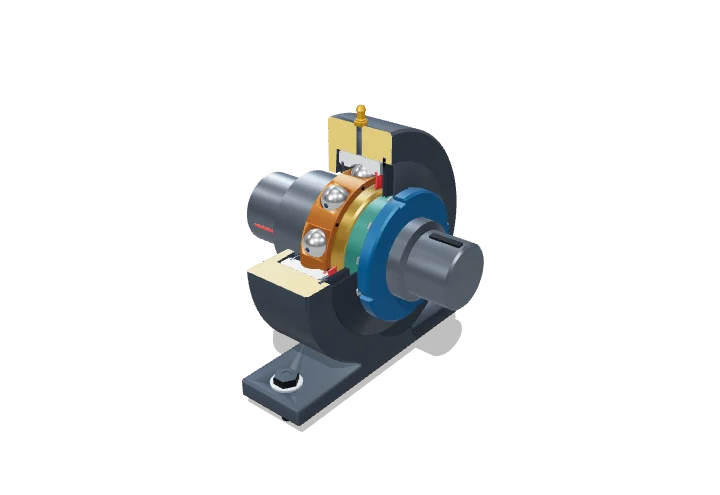 Open the interactive 3D model →
How can a car wheel or an electric fan spin for years without wearing out its axle?
A ball bearing lets a shaft turn with very little friction. Hard steel balls roll between two rings, so the parts roll over each other instead of rubbing. A thin cage keeps the balls evenly spaced.
A deep-groove ball bearing supports a rotating shaft by letting hardened balls roll between grooved inner and outer rings, replacing sliding friction with rolling friction roughly a hundred times smaller. Its life is limited not by wear but by rolling-contact fatigue, predicted statistically by the L₁₀ equation: life falls with the cube of the load.
Key facts
- Model bearing
- 6205-2RS: bore 25 mm, outside Ø 52 mm, width 15 mm, 9 balls Ø 7.94 mm
- Cage speed (outer ring fixed)
- (1 − D/d_m)/2 ≈ 0.397 × shaft speed
- Friction coefficient
- ≈ 0.001–0.002 (deep-groove ball bearing)
- Rating life (ball bearings)
- L₁₀ = (C/P)³ million revolutions
- Ring and ball steel
- 100Cr6 / AISI 52100, ≈ 58–65 HRC
- Peak contact stress, normal duty
- ≈ 1.5–2.5 GPa
Parts you can explore (13)
- Outer ring
- Inner ring
- Balls
- Cage
- Front seal
- Rear shield
- Shaft
- Shaft spacer
- Locknut & lock washer
- Housing
- Outer retaining ring
- Grease fitting
- Housing bolts
In the 3D model
Rotate and take apart the model, follow a guided tour of what each part does and why it’s needed, change it with a live slider, and test yourself with a short quiz. Free, no sign-up.
Open Deep-groove ball bearing in 3D →
OpenArc Models’ models are simplified teaching schematics. Terms · Privacy