Cells & molecules
Bacteriophage T4
Virology · Bacterial virus
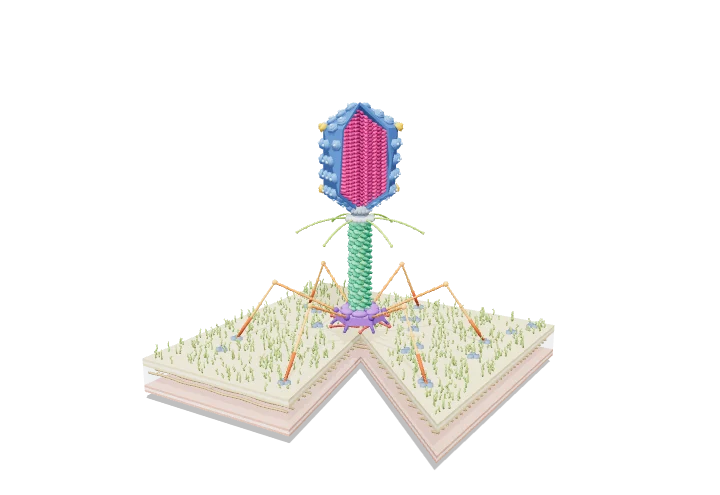 Open the interactive 3D model →
How does a virus with no engine and no fuel punch its DNA into a bacterium?
Bacteriophage T4 is a virus that only attacks bacteria. It lands on a bacterium with its spidery legs, then its tail snaps shorter like a released spring and drives a hollow needle through the cell wall. The virus’s DNA then slides out of its head, down the needle and into the cell, which it turns into a phage factory.
Bacteriophage T4 is a tailed, double-stranded DNA virus that infects Escherichia coli by attaching to the cell surface and injecting its genome through a contractile tail. The tail is a pre-loaded molecular machine: receptor binding by the fibres triggers a baseplate switch, the sheath contracts without using ATP, and the rigid tube punctures the envelope so the DNA can enter the cytoplasm.
Key facts
- Head
- Prolate icosahedron ≈ 111 × 78 nm
- Genome
- ≈ 169 kbp linear dsDNA, ~300 genes
- Tail sheath
- ≈ 98 nm extended → ≈ 42 nm contracted
- Long tail fibres
- 6 × ≈ 145 nm, kinked at the knee
- Host
- Escherichia coli (receptors: OmpC, LPS)
- Burst size
- ≈ 100–200 progeny per cell
Parts you can explore (12)
- Capsid head
- Packaged DNA
- Neck & collar
- Whiskers
- Tail sheath
- Tail tube
- Baseplate
- Long tail fibres
- Short tail fibres
- Outer membrane & LPS
- Peptidoglycan & periplasm
- Inner membrane
In the 3D model
Rotate and take apart the model, follow a guided tour of what each part does and why it’s needed, change it with a live slider, and test yourself with a short quiz. Free, no sign-up.
OpenArc Models’ models are simplified teaching schematics. Terms · Privacy