Cells & molecules
Bacterial cell
Microbiology · Prokaryotic cell
 Open the interactive 3D model →
How does a living thing hundreds of times smaller than a grain of sand swim, sense food and copy itself?
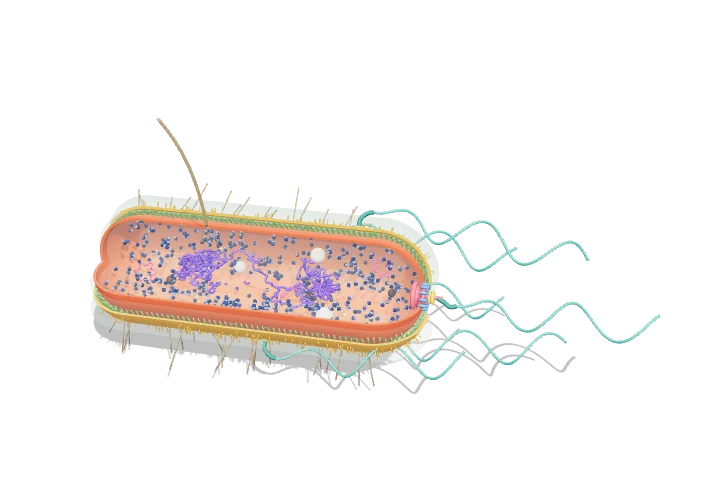
A bacterium like E. coli is a single tiny cell, about 2 micrometres long, with no nucleus inside. It is wrapped in layers of skin and a tough wall, keeps its DNA in a loose tangle in the middle, and swims by spinning long corkscrew-shaped tails with tiny rotary motors. Every 20 minutes or so, in good conditions, it can split into two.
Bacteria are prokaryotes: their DNA lies in a nucleoid in the cytoplasm, with no nucleus or membrane-bound organelles, and the plasma membrane does the work that mitochondria do in eukaryotes. A Gram-negative rod such as Escherichia coli is wrapped in a layered envelope — inner membrane, thin peptidoglycan wall and outer membrane — and swims by rotating helical flagella with ion-driven motors.
Key facts
- Size (E. coli)
- ≈ 1–2 µm long, 0.8–1 µm wide; volume ≈ 1 fL
- Chromosome
- ≈ 4.6 Mb circular DNA, ≈ 4,300 protein-coding genes
- Ribosomes per cell
- ≈ 10,000–70,000, rising with growth rate
- Doubling time
- ≈ 20 min in rich medium at 37 °C
- Flagella
- ≈ 4–8 per cell; filaments ≈ 20 nm thick, 5–10 µm long
- Swimming speed
- ≈ 20–30 µm/s (≈ 10–15 body lengths per second)
Parts you can explore (13)
- Capsule
- Outer membrane
- Periplasm
- Peptidoglycan
- Plasma membrane
- Cytoplasm
- Nucleoid
- Plasmids
- Ribosomes
- Storage granules
- Flagellar motor
- Flagellum
- Pili
In the 3D model
Rotate and take apart the model, follow a guided tour of what each part does and why it’s needed, change it with a live slider, and test yourself with a short quiz. Free, no sign-up.
OpenArc Models’ models are simplified teaching schematics. Terms · Privacy