Fluids & heat
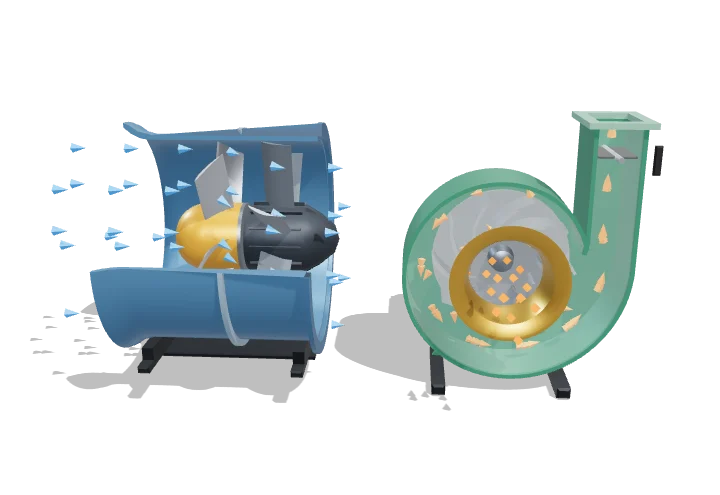
Axial fan and centrifugal blower
Fluid machinery · Fans and fan laws
 Open the interactive 3D model →
Why do some fans blow air straight through while others suck it in the middle and spit it out sideways?
Fans push air by spinning blades. An axial fan, like a desk fan, uses twisted blades shaped like small wings to push air straight along its shaft. A centrifugal blower, like the one in a hair dryer, flings air outward from a spinning wheel into a snail-shaped case, which builds up more pressure but moves less air.
Fans are turbomachines that add energy to air by changing its angular momentum: an axial fan does it with twisted aerofoil blades that push air along the shaft, while a centrifugal blower throws air outward from an impeller into a spiral scroll. For a given fan the fan laws link speed to performance — flow rises with speed, pressure with speed squared and power with speed cubed.
Key facts
- Fan laws (fixed fan, fixed air density)
- Q ∝ N, Δp ∝ N², P ∝ N³
- Axial fan (this model, 1450 rpm)
- ≈ 1.2 m³/s at ≈ 180 Pa (Ø ≈ 425 mm)
- Centrifugal blower (this model, 1450 rpm)
- ≈ 0.43 m³/s at ≈ 370 Pa (impeller Ø 310 mm)
- Peak total efficiency
- ≈ 65–85 % axial; ≈ 75–90 % backward-curved centrifugal
- Typical pressure rise
- Axial ≈ 50–1500 Pa; centrifugal up to ≈ 10 kPa or more
- Pressure rise is small
- 370 Pa is only ≈ 0.4 % of atmospheric pressure, so air is treated as incompressible
Parts you can explore (12)
- Axial fan housing
- Hub and spinner
- Axial rotor blades
- Axial fan motor
- Outlet guide vanes
- Scroll housing
- Inlet cone
- Impeller
- Blower motor
- Mounting frames
- Discharge damper
- Flow arrows
In the 3D model
Rotate and take apart the model, follow a guided tour of what each part does and why it’s needed, change it with a live slider, and test yourself with a short quiz. Free, no sign-up.
Open Axial fan and centrifugal blower in 3D →
OpenArc Models’ models are simplified teaching schematics. Terms · Privacy