Mechanisms
4-speed automatic transmission
Mechanisms · Automotive drivetrain
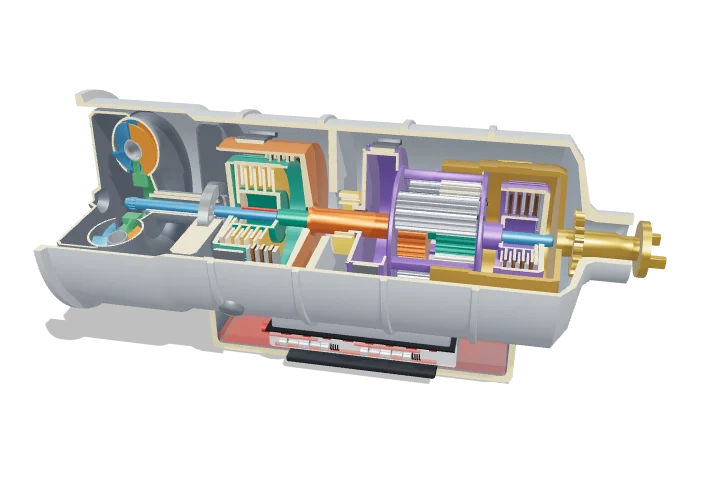 Open the interactive 3D model →
How does an automatic gearbox change gear when none of its gears ever slide in or out of mesh?
An automatic gearbox has a clever set of gears, called a planetary set, that are always meshed together. It changes gear by grabbing some of those gears to make them turn with the engine and clamping others so they cannot turn. Oil pressure, steered by a little hydraulic “brain”, does the grabbing and clamping.
A planetary automatic transmission obtains several gear ratios from gears that are always in mesh, by using hydraulically applied clutches to drive chosen members of a planetary gearset and bands or one-way clutches to hold others still. A torque converter couples it to the engine, and a valve body — today under electronic control — decides which elements apply and when.
Key facts
- Gearset modelled
- Ravigneaux: suns 30 T and 36 T, pinions 15 T and 18 T, ring 72 T
- Ratios
- 2.40 / 1.47 / 1.00 / 0.67, reverse 2.00 (Ford AOD-type)
- Shift elements
- 3 clutches, 2 bands, 1 one-way clutch
- Elements applied per gear
- two (any two fix a 2-degree-of-freedom set)
- Line pressure
- ≈ 4–17 bar (60–250 psi), varied with throttle
- Modern designs
- 8–10 forward speeds from 4–5 planetary sets
Parts you can explore (16)
- Torque converter
- Oil pump
- Input shaft
- Forward clutch
- Reverse clutch
- 2–4 band
- Sun gears
- Planet pinions
- Planet carrier
- Ring gear
- Low–reverse band
- One-way clutch
- Direct clutch
- Output shaft
- Valve body
- Transmission case
In the 3D model
Rotate and take apart the model, follow a guided tour of what each part does and why it’s needed, change it with a live slider, and test yourself with a short quiz. Free, no sign-up.
Open 4-speed automatic transmission in 3D →
OpenArc Models’ models are simplified teaching schematics. Terms · Privacy