Cells & molecules
ATP synthase
Biochemistry · Molecular motor
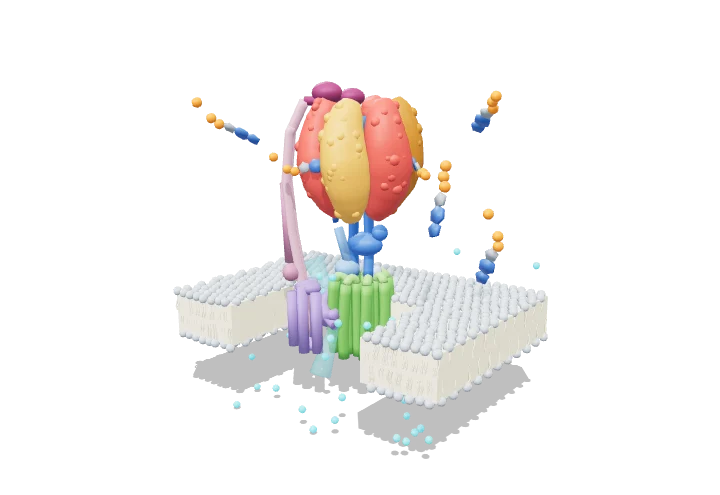 Open the interactive 3D model →
Did you know your cells contain trillions of tiny spinning motors?
ATP synthase is a protein machine in your mitochondria that makes ATP, the molecule cells use as energy money. Protons (tiny charged particles) flowing through it make a ring inside it spin, like water turning a mill wheel. The spinning shaft squeezes the machine’s head into different shapes, and each squeeze builds one ATP molecule.
ATP synthase is a rotary molecular machine that converts the energy of a proton gradient across a membrane into the chemical energy of ATP. Protons flowing through the membrane-embedded F₀ turn a rotor whose asymmetric shaft drives the three catalytic sites of the F₁ head through a binding-change cycle.
Key facts
- Mass (bovine monomer)
- ≈ 600 kDa; about 17 kinds of subunit
- F₁ head
- α₃β₃ hexamer ≈ 10 nm across
- c-ring
- 8 subunits in vertebrates (10 in yeast and E. coli, 14 in chloroplasts)
- H⁺ per ATP (mammals)
- 8/3 ≈ 2.7 through F₀ (≈ 3.7 incl. phosphate import)
- ATP per rotor turn
- 3
- Maximum rotation rate
- ≈ 100–130 rev/s (isolated F₁, hydrolysis)
Parts you can explore (10)
- Inner mitochondrial membrane
- c-ring (c₈)
- a-subunit & half-channels
- Central stalk (γδε)
- α-subunits (α₃)
- β-subunits (β₃)
- Peripheral stalk (b, d, F6)
- OSCP
- Protons (H⁺)
- ADP, Pi & ATP
In the 3D model
Rotate and take apart the model, follow a guided tour of what each part does and why it’s needed, change it with a live slider, and test yourself with a short quiz. Free, no sign-up.
OpenArc Models’ models are simplified teaching schematics. Terms · Privacy