Chemistry
ATP and its hydrolysis
Biochemistry · Bioenergetics
 Open the interactive 3D model →
Your body recycles about its own weight in ATP every day — what is this molecule for?
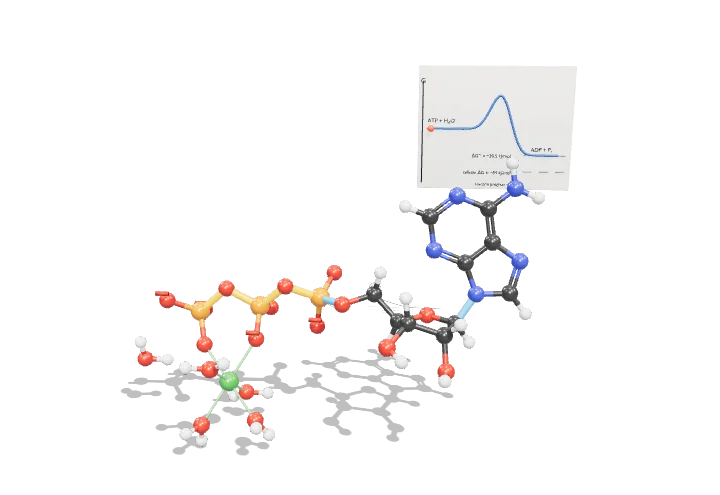
ATP is the energy currency of every living cell. It is made of a base called adenine, a sugar called ribose and a chain of three phosphate groups. When water snaps off the last phosphate, ATP becomes ADP plus a loose phosphate and energy is released, which cells use to move muscles, pump substances and build molecules.
Adenosine triphosphate is a nucleotide — adenine, ribose and a chain of three phosphates — whose terminal phosphoanhydride bond is hydrolysed to give ADP and inorganic phosphate with ΔG°′ = −30.5 kJ mol⁻¹. Because cells hold ATP far above its equilibrium ratio with ADP and Pᵢ, the actual free-energy change is about −50 kJ mol⁻¹, and coupling this reaction to others pays for biosynthesis, transport and movement.
Key facts
- Formula (free acid)
- C₁₀H₁₆N₅O₁₃P₃, M = 507.18 g mol⁻¹
- ΔG°′ (ATP → ADP + Pᵢ)
- −30.5 kJ mol⁻¹ (−7.3 kcal mol⁻¹)
- ΔG in a typical cell
- ≈ −50 kJ mol⁻¹ (−45 to −65 depending on cell type)
- Charge at pH 7
- ≈ −4 (ATP⁴⁻), mostly bound as Mg·ATP²⁻
- Cellular concentration
- ≈ 1–10 mM ATP
- Daily turnover (adult human)
- Roughly body mass in ATP (~ 40–60 kg) recycled per day
Parts you can explore (11)
- Adenine
- Ribose
- α-phosphate
- β-phosphate
- γ-phosphate
- Phosphoanhydride bonds
- Ester & glycosidic links
- Mg²⁺ coordination
- Attacking water
- Negative charges
- Free-energy diagram
In the 3D model
Rotate and take apart the model, follow a guided tour of what each part does and why it’s needed, change it with a live slider, and test yourself with a short quiz. Free, no sign-up.
Open ATP and its hydrolysis in 3D →
OpenArc Models’ models are simplified teaching schematics. Terms · Privacy