Chemistry
Atomic orbitals
Physical chemistry · Quantum mechanics
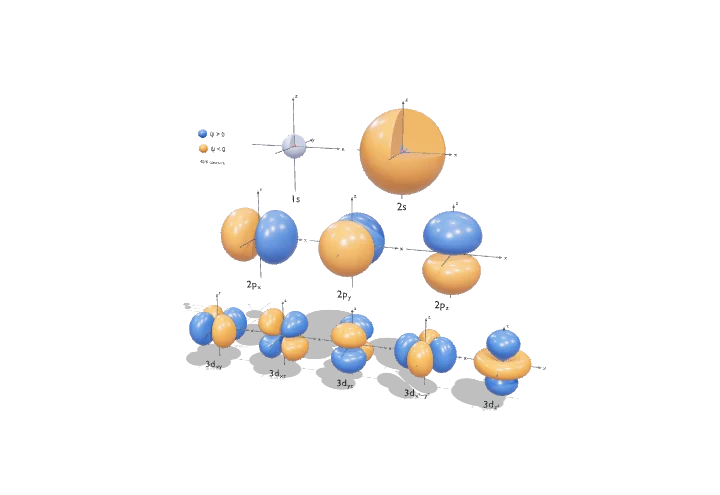 Open the interactive 3D model →
If electrons do not circle the nucleus like planets, where are they — and why the strange shapes?
An electron in an atom is not a tiny ball on a track; it behaves like a wave spread out around the nucleus. An orbital is the shape of that wave, and the surfaces here enclose the region where the electron is found 90% of the time. Bigger orbitals have more energy, and the flat or round gaps where the wave is exactly zero, called nodes, give each orbital its shape.
An atomic orbital is a one-electron wavefunction ψ(r, θ, φ), a solution of the Schrödinger equation labelled by the quantum numbers n, ℓ and m. Its shape comes from the angular part, which fixes the number of nodal planes or cones, its size and radial nodes come from the radial part, and |ψ|² gives the probability density of finding the electron.
Key facts
- Hydrogen energy levels
- Eₙ = −13.606 eV / n² (−13.6, −3.40, −1.51 eV for n = 1, 2, 3)
- Bohr radius a₀
- 52.92 pm (0.5292 Å)
- Nodes
- n − 1 in total: ℓ angular + (n − ℓ − 1) radial
- Orbitals per shell
- n² (1, 4, 9 for n = 1, 2, 3); up to 2n² electrons
- Most probable radius, 1s
- r = a₀; mean ⟨r⟩ = 1.5 a₀
- 90% contour, 1s
- r ≈ 2.66 a₀ ≈ 1.41 Å
Parts you can explore (12)
- 1s orbital
- 2s orbital
- 2p_x orbital
- 2p_y orbital
- 2p_z orbital
- 3d_xy orbital
- 3d_xz orbital
- 3d_yz orbital
- 3d_x²−y² orbital
- 3d_z² orbital
- Nuclei
- Axes & labels
In the 3D model
Rotate and take apart the model, follow a guided tour of what each part does and why it’s needed, change it with a live slider, and test yourself with a short quiz. Free, no sign-up.
OpenArc Models’ models are simplified teaching schematics. Terms · Privacy