Earth & space
Atmosphere layers
Earth science · Atmosphere
 Open the interactive 3D model →
If air gets colder as you climb a mountain, why is the air 100 km up hotter than a pizza oven?
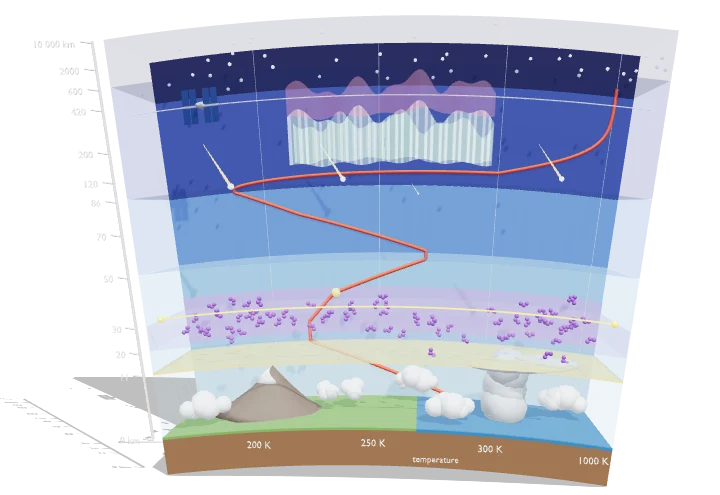
Earth’s air is stacked in layers, and each layer is marked by whether it gets colder or warmer as you go up. Near the ground the air is warmed by the land, so it cools with height and makes our weather; higher up, ozone and then the thinnest air soak up sunlight and get warmer again. The air also gets thinner the higher you go, until it fades into space.
Earth’s atmosphere is divided into layers by how temperature changes with height: the troposphere, stratosphere, mesosphere, thermosphere and exosphere. Pressure, by contrast, falls smoothly and nearly exponentially, halving roughly every 5.5 km near the surface.
Key facts
- Sea-level standard pressure
- 101.325 kPa (1013.25 hPa)
- Pressure scale height
- ≈ 7–8.5 km (≈ 8.4 km at 288 K)
- Mass below 5.5 km / 16 km
- ≈ 50% / ≈ 90%
- Tropospheric lapse rate (standard)
- 6.5 K per km
- Coldest point (mesopause)
- ≈ 187 K (−86 °C) at 86–90 km
- Karman line (conventional edge of space)
- 100 km
Parts you can explore (15)
- Earth's surface
- Troposphere
- Clouds and weather
- Tropopause
- Stratosphere
- Ozone layer
- Mesosphere
- Meteors
- Thermosphere
- Aurora
- ISS orbit
- Exosphere
- Temperature profile
- Altitude scale
- Altitude probe
In the 3D model
Rotate and take apart the model, follow a guided tour of what each part does and why it’s needed, change it with a live slider, and test yourself with a short quiz. Free, no sign-up.
Open Atmosphere layers in 3D →
OpenArc Models’ models are simplified teaching schematics. Terms · Privacy