Astronomy & space
Asteroids: rubble piles and metal worlds
Planetary science · Small bodies
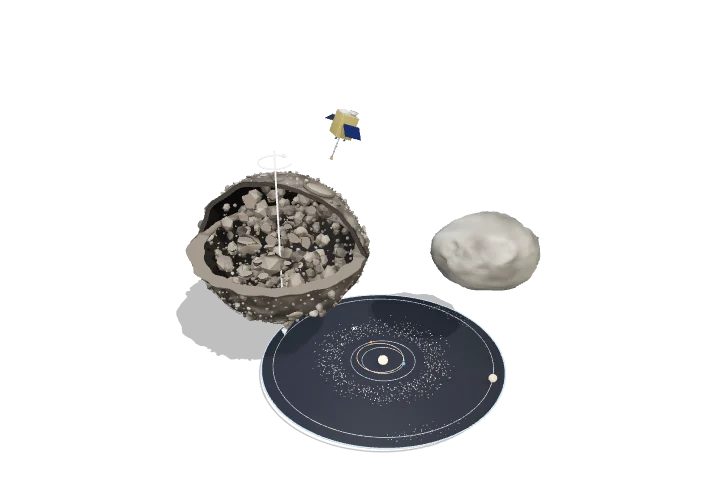 Open the interactive 3D model →
Is an asteroid a giant solid rock — or something much stranger?
Asteroids are rocky and metal leftovers from when the planets formed 4.6 billion years ago, and most of them circle the Sun between Mars and Jupiter. Many small ones, like Bennu, are not solid at all but loose piles of boulders and gravel with lots of empty space inside, held together by very weak gravity. In 2020 a NASA spacecraft touched Bennu for a few seconds and brought a handful of it back to Earth.
Asteroids are rocky and metallic leftovers of planet formation, most of them orbiting in the main belt between Mars and Jupiter. Small ones like Bennu are often rubble piles — loose aggregates of boulders held together by weak gravity — while large ones like Psyche may preserve fragments of planetary interiors.
Key facts
- Bennu size
- ≈ 490 m mean diameter (565 × 535 × 508 m)
- Bennu bulk density
- ≈ 1.19 g/cm³ (≈ 50 % macroporosity)
- Bennu rotation
- 4.30 h, retrograde
- Psyche size
- ≈ 280 × 232 × 189 km
- Main belt
- ≈ 2.1–3.3 AU; total mass ≈ 3 % of the Moon’s
- OSIRIS-REx sample
- 121.6 g returned to Earth, 24 September 2023
Parts you can explore (11)
- Bennu surface
- Equatorial ridge
- Boulders
- Fine regolith
- Rubble interior
- Spin axis
- Psyche
- Sun and planet orbits
- Asteroid belt
- OSIRIS-REx
- TAGSAM sampler
In the 3D model
Rotate and take apart the model, follow a guided tour of what each part does and why it’s needed, change it with a live slider, and test yourself with a short quiz. Free, no sign-up.
Open Asteroids: rubble piles and metal worlds in 3D →
OpenArc Models’ models are simplified teaching schematics. Terms · Privacy