Human body
Artery and vein walls
Anatomy · Cardiovascular system · Histology
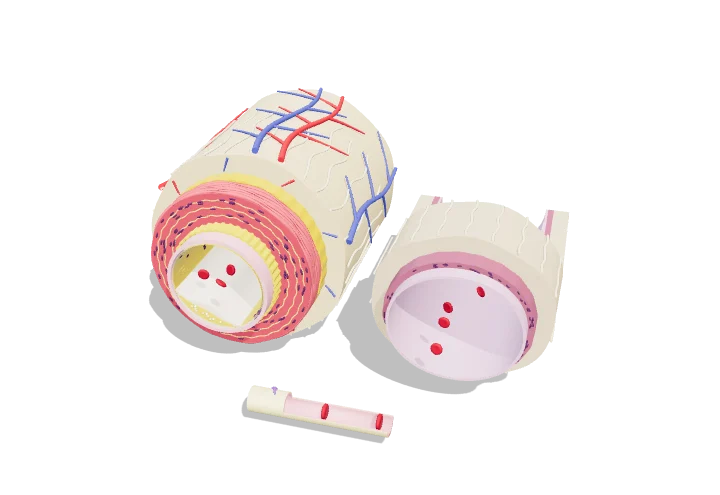 Open the interactive 3D model →
Why are arteries thick and springy while veins are thin and floppy, when both carry the same blood?
Arteries carry blood away from the heart at high pressure, so their walls are thick, muscular and stretchy. Veins bring blood back at low pressure, so their walls are thin, and they have little one-way valves to stop blood sliding backwards. Between them, tiny capillaries have walls just one cell thick so that oxygen and food can pass through to your body.
All blood vessels except capillaries share a three-layered wall — intima, media and adventitia — whose proportions reflect the pressure and job of each vessel. Muscular arteries have a thick smooth-muscle media that controls resistance, veins have thin walls and valves that store and return blood, and capillaries are reduced to a single endothelial layer for exchange.
Key facts
- Muscular artery diameter
- ≈ 0.5–10 mm (e.g. radial, coronary)
- Wall thickness / lumen radius
- artery ≈ 0.5–1; vein ≈ 0.1
- Capillary diameter
- ≈ 5–10 µm; wall ≈ 0.5 µm
- Normal resting BP
- < 120/80 mmHg
- Blood volume in systemic veins
- ≈ 60–65%
- Endothelial surface area
- ≈ 1000–4000 m² (estimates vary)
Parts you can explore (11)
- Tunica intima
- Internal elastic lamina
- Tunica media
- External elastic lamina
- Tunica adventitia
- Vasa vasorum
- Vein wall
- Venous valve
- Capillary
- Red blood cells
- Atherosclerotic plaque
In the 3D model
Rotate and take apart the model, follow a guided tour of what each part does and why it’s needed, change it with a live slider, and test yourself with a short quiz. Free, no sign-up.
Open Artery and vein walls in 3D →
OpenArc Models’ models are simplified teaching schematics. Terms · Privacy