Earth & space
Aquifers and wells
Earth science · Hydrogeology
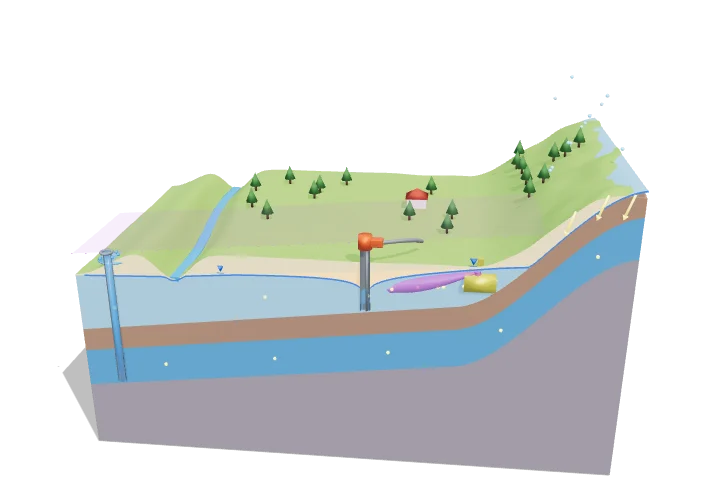 Open the interactive 3D model →
How can water gush out of a well by itself, with no pump at all?
Underground water is not usually in lakes or rivers: it fills the tiny spaces between grains of sand and gravel, like water in a sponge. Wells reach down into these wet layers, called aquifers, and pumps pull the water up. Where a wet layer is trapped under clay and fed from higher hills, the water is under pressure and can rise out of a well on its own.
Groundwater fills the pores and fractures of rock and sediment below the water table and flows slowly from recharge areas to discharge areas such as streams, springs and wells, at rates governed by Darcy’s law. Unconfined aquifers are open to the surface, while confined aquifers are sealed by aquitards and hold water under pressure; pumping a well lowers the hydraulic head around it in a cone of depression that can capture nearby water and pollutants.
Key facts
- Share of Earth’s fresh water in the ground
- ≈ 30% (≈ 99% of the liquid, non-frozen part)
- Porosity of sand and gravel
- ≈ 25–40%
- Hydraulic conductivity
- gravel ≈ 10⁻³–10⁻¹ m/s; sand ≈ 10⁻⁵–10⁻³ m/s; clay < 10⁻⁹ m/s
- Typical groundwater velocity
- ≈ centimetres to metres per day
- Drawdown with distance
- falls off with ln(R/r) in steady radial flow (Thiem)
- Groundwater share of global irrigation
- ≈ 40%
Parts you can explore (14)
- Unsaturated zone
- Water table
- Unconfined aquifer
- Cone of depression
- Aquitard
- Confined aquifer
- Bedrock
- Recharge zone
- Potentiometric surface
- Pumping well
- Artesian well
- Contamination plume
- Gaining stream
- Groundwater flow
In the 3D model
Rotate and take apart the model, follow a guided tour of what each part does and why it’s needed, change it with a live slider, and test yourself with a short quiz. Free, no sign-up.
Open Aquifers and wells in 3D →
OpenArc Models’ models are simplified teaching schematics. Terms · Privacy