Mechanisms
Antikythera mechanism
Mechanisms · History of astronomy
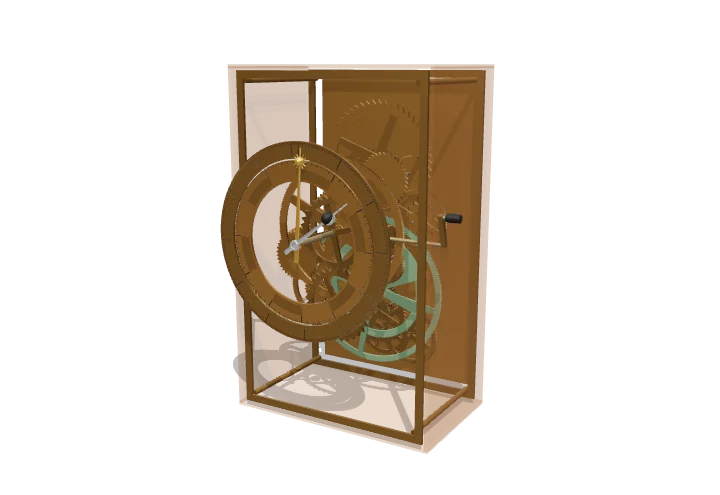 Open the interactive 3D model →
How did ancient Greeks predict eclipses with a shoebox full of bronze gears, 2,000 years ago?
The Antikythera mechanism is a hand-cranked bronze machine found in a shipwreck. Turning its handle moved pointers that showed where the Sun and Moon were in the sky, the Moon’s phase, a calendar and the months when eclipses would happen. It did this with carefully counted gear teeth that matched the rhythms of the sky.
The Antikythera mechanism is a hand-cranked bronze gear train, made in the Greek world in roughly the 2nd century BC, that calculated and displayed the positions of the Sun and Moon, the lunar phase, a 19-year luni-solar calendar and the 223-month Saros eclipse cycle. Its gear ratios encode Babylonian and Greek period relations exactly — 254 sidereal months in 19 years, 235 synodic months in 19 years, 223 synodic months per Saros — and a pin-and-slot pair of gears reproduces the Moon’s varying speed described by Hipparchus.
Key facts
- Found
- 1901, Antikythera shipwreck (Greece); recognised as a gearwork in 1902
- Date
- made c. 200–60 BC (estimates vary)
- Survives as
- 82 fragments with 30 gears
- Moon train ratio
- 64·48·127 / (38·24·32) = 254/19 sidereal months per year
- Back dials
- Metonic 235 months (5-turn spiral), Saros 223 months (4-turn spiral)
- Lunar anomaly
- pin-and-slot gears k1/k2, ≈ ±6° in this model
Parts you can explore (13)
- Main drive wheel
- Date crank
- Lunar gear train
- Pin-and-slot gearing
- Metonic train
- Saros train
- Front dial
- Sun pointer
- Moon pointer and phase ball
- Metonic dial
- Saros dial
- Frame plates
- Wooden case
In the 3D model
Rotate and take apart the model, follow a guided tour of what each part does and why it’s needed, change it with a live slider, and test yourself with a short quiz. Free, no sign-up.
Open Antikythera mechanism in 3D →
OpenArc Models’ models are simplified teaching schematics. Terms · Privacy