Cells & molecules
Antibody (IgG)
Immunology · Protein structure
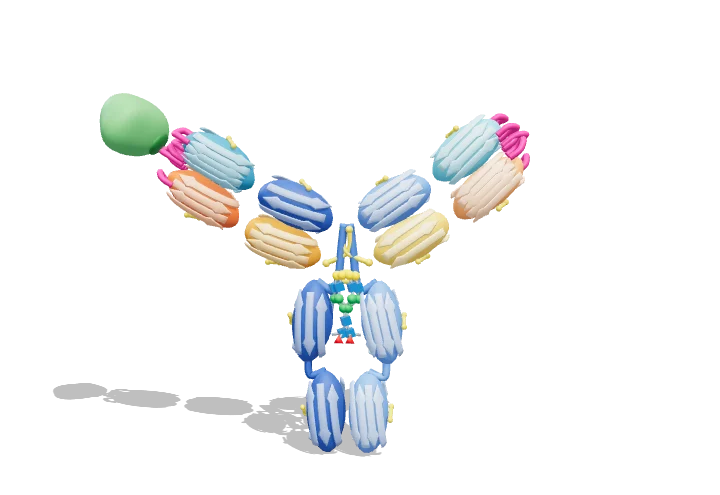 Open the interactive 3D model →
How does your body make a molecule that can grab one particular virus out of billions of other things?
An antibody is a Y-shaped protein your immune cells make to fight infection. The two tips of the Y are shaped to grip one specific target, such as a spot on a virus, like a key fits one lock. The stem of the Y then signals other immune cells to come and destroy whatever the antibody has grabbed.
Immunoglobulin G is a 150 kDa Y-shaped protein built from two heavy and two light chains folded into twelve immunoglobulin domains. Its two Fab arms bind antigen through six hypervariable CDR loops each, while its Fc stem recruits immune effector functions.
Key facts
- Molecular mass
- ≈ 150 kDa (2 × ≈ 50 kDa heavy + 2 × ≈ 25 kDa light)
- Domains
- 12 Ig domains of ≈ 110 residues: VH, CH1–CH3 ×2; VL, CL ×2
- Antigen-binding sites
- 2 (bivalent), each formed by 6 CDR loops
- Span
- ≈ 14–15 nm between Fab tips (varies with hinge flexing)
- Serum half-life
- ≈ 21 days (IgG1, IgG2, IgG4), via FcRn recycling
- Typical affinity (Kd)
- ≈ 10⁻⁷–10⁻¹⁰ M after affinity maturation
Parts you can explore (11)
- VH domains
- VL domains
- CH1 domains
- CL domains
- Hinge region
- CH2 domains
- CH3 domains
- Disulfide bonds
- CDR loops
- Antigen
- N-linked glycans
In the 3D model
Rotate and take apart the model, follow a guided tour of what each part does and why it’s needed, change it with a live slider, and test yourself with a short quiz. Free, no sign-up.
OpenArc Models’ models are simplified teaching schematics. Terms · Privacy