Plants & animals
Ant and colony
Insects · Social insects
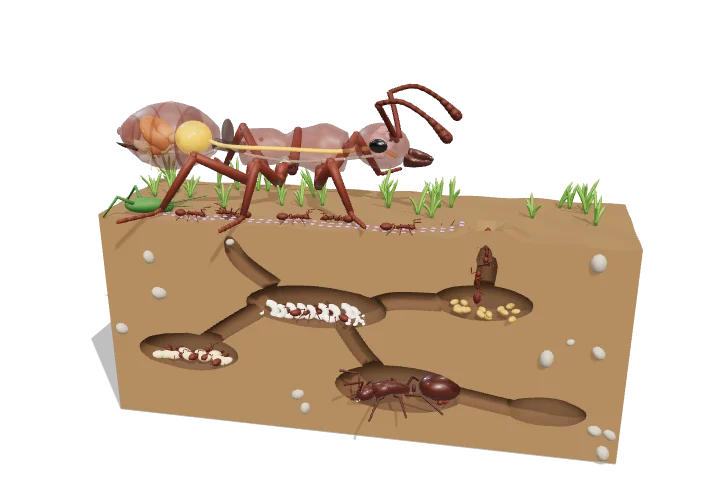 Open the interactive 3D model →
How do thousands of ants find the best food without any ant being in charge?
An ant has three main body parts, a narrow waist, and feelers called antennae that it uses to smell and touch. Ants live in colonies where one queen lays the eggs and thousands of worker sisters do everything else. When a worker finds food it leaves a scent trail home, and the more ants follow it, the stronger the trail gets.
Ants are eusocial insects whose workers share a body plan of head, mesosoma, narrow petiole and gaster, with elbowed antennae, versatile mandibles, a crop for sharing food and, in many species, a sting. Colonies divide labour between a reproductive queen and sterile workers, and coordinate foraging with pheromone trails that are reinforced or allowed to fade.
Key facts
- Described species
- ≈ 14,000–16,000
- Worker length
- ≈ 1–30 mm; most 2–10 mm
- Ants on Earth
- ≈ 2 × 10¹⁶ individuals (2022 estimate)
- Colony size
- Dozens to millions of workers
- Queen lifespan
- Up to ≈ 28 years in Lasius niger (laboratory)
- Sister relatedness
- r = 0.75 under haplodiploidy (single, once-mated queen)
Parts you can explore (16)
- Head
- Mandibles
- Antennae
- Compound eyes
- Mesosoma
- Legs
- Petiole
- Gaster
- Brain
- Crop and gut
- Stinger
- Nest chambers
- Queen
- Brood
- Workers
- Pheromone trail
In the 3D model
Rotate and take apart the model, follow a guided tour of what each part does and why it’s needed, change it with a live slider, and test yourself with a short quiz. Free, no sign-up.
OpenArc Models’ models are simplified teaching schematics. Terms · Privacy