Plants & animals
Amoeba
Protists · Amoebozoa
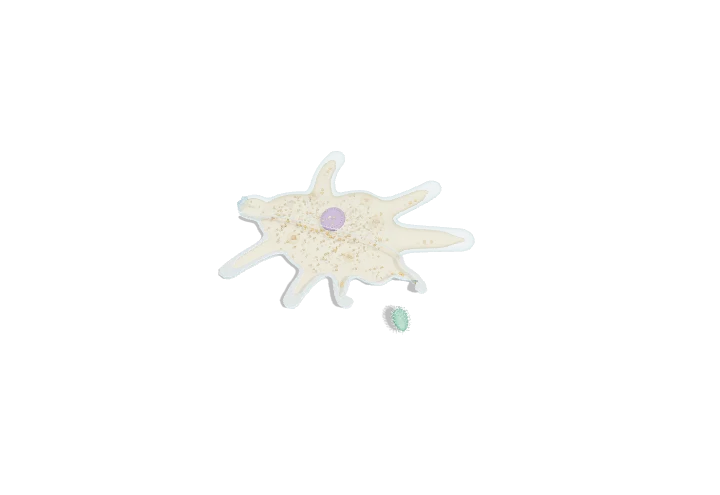 Open the interactive 3D model →
How does a single cell with no legs, no mouth and no fixed shape hunt down its food?
An amoeba is one living cell, just big enough to see as a speck in pond water. It moves by squeezing its jelly-like insides forward into bulges called pseudopodia ("false feet"), so its shape is always changing. To eat, it wraps two of these bulges around its prey and swallows it whole.
Amoeba proteus is a giant free-living amoeba that crawls by extending lobe-shaped pseudopodia, driven by actin–myosin contraction of its cortex and the forward streaming of fluid endoplasm through a tube of stiffer ectoplasm. The same machinery lets it engulf whole prey cells by phagocytosis, digest them in food vacuoles and stay intact in fresh water with a contractile vacuole.
Key facts
- Length when extended
- ≈ 250–750 µm (visible to the naked eye as a speck)
- Classification
- Amoebozoa · Tubulinea (lobose amoebae)
- Nucleus
- One, disc-shaped, ≈ 40–50 µm across
- Crawling speed
- A few µm/s; strongly dependent on temperature and ions
- Feeding
- Phagocytosis of ciliates, flagellates, algae and bacteria
- Reproduction
- Binary fission (mitosis); no sexual stage known
Parts you can explore (11)
- Plasma membrane
- Pseudopodia
- Food cup
- Ectoplasm
- Endoplasm
- Uroid
- Nucleus
- Contractile vacuole
- Food vacuoles
- Prey ciliate
- Cytoplasmic granules
In the 3D model
Rotate and take apart the model, follow a guided tour of what each part does and why it’s needed, change it with a live slider, and test yourself with a short quiz. Free, no sign-up.
OpenArc Models’ models are simplified teaching schematics. Terms · Privacy