Human body
Alveoli & gas exchange
Anatomy · Respiratory system
 Open the interactive 3D model →
How does oxygen get from the air you breathe into your blood in less than a second?
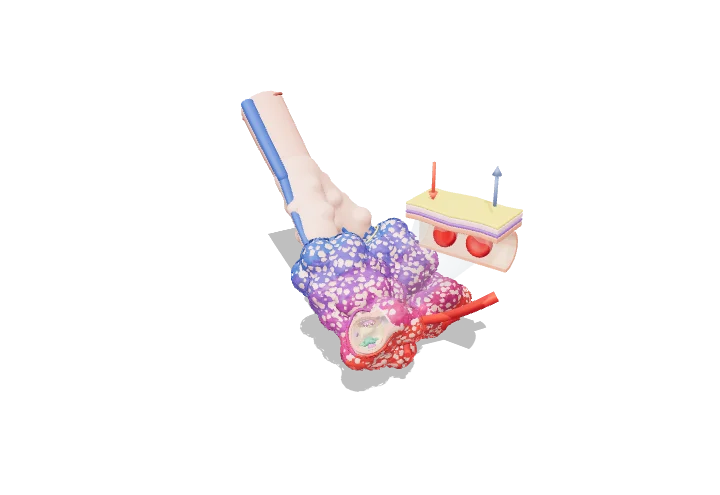
Your airways branch again and again until they end in about 480 million tiny air bubbles called alveoli. Each one is wrapped in a net of very thin blood vessels, and the wall between air and blood is about 100 times thinner than a sheet of paper. Oxygen simply drifts across that thin wall into the blood, and carbon dioxide drifts out.
Beyond the terminal bronchiole the airways end in hundreds of millions of thin-walled alveoli, each wrapped in a sheet of capillary blood. Oxygen and carbon dioxide cross the half-micrometre blood–air barrier by passive diffusion, driven by partial-pressure differences that ventilation maintains.
Key facts
- Number of alveoli (adult)
- ≈ 480 million (range ≈ 270–790 million)
- Alveolar surface area
- ≈ 70–130 m²
- Blood–air barrier
- ≈ 0.2–0.6 µm at its thinnest
- Alveolar PO₂ / PCO₂
- ≈ 100 / 40 mmHg
- Mixed venous PO₂ / PCO₂
- ≈ 40 / 46 mmHg
- Capillary transit time (rest)
- ≈ 0.75 s; O₂ equilibrates in ≈ 0.25 s
Parts you can explore (14)
- Terminal bronchiole
- Respiratory bronchioles
- Alveolar ducts
- Alveolar sacs
- Pulmonary capillaries
- Pulmonary arteriole
- Pulmonary venule
- Type I pneumocytes
- Type II pneumocytes
- Alveolar macrophage
- Surfactant layer
- Red blood cells
- Smooth muscle & elastic fibres
- Respiratory membrane (inset)
In the 3D model
Rotate and take apart the model, follow a guided tour of what each part does and why it’s needed, change it with a live slider, and test yourself with a short quiz. Free, no sign-up.
Open Alveoli & gas exchange in 3D →
OpenArc Models’ models are simplified teaching schematics. Terms · Privacy