Fluids & heat
Aerofoil lift and stall
Fluid mechanics · Aerodynamics
 Open the interactive 3D model →
How does a wing hold up a plane — and why does it suddenly stop working if it tilts too far?
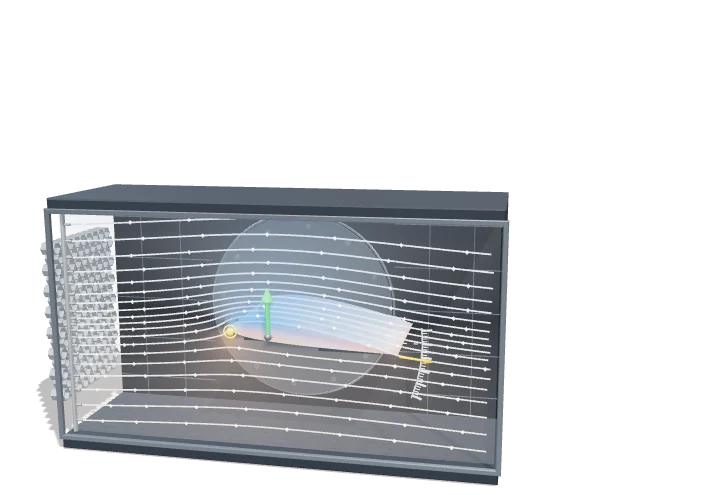
A wing is shaped and tilted so that it bends the passing air downward. Bending the air makes the pressure above the wing lower than the pressure below, and that difference pushes the wing up. Tilt it too steeply and the air can no longer follow the top surface: it breaks away, the lift collapses and the wing “stalls”.
An aerofoil makes lift by turning the oncoming air downward: the flow speeds up over the upper surface and slows near the lower leading edge, so pressure is lower above than below. Lift grows almost linearly with angle of attack until the upper-surface boundary layer separates, at which point the section stalls, lift falls and drag rises steeply.
Key facts
- Section
- NACA 2412: 2 % camber at 40 % chord, 12 % thickness
- Zero-lift angle α₀
- ≈ −2°
- Lift-curve slope
- ≈ 0.10–0.11 per degree (thin-aerofoil theory: 2π per radian ≈ 0.11/°)
- Maximum lift coefficient
- ≈ 1.6–1.7 near α ≈ 16° (Re ≈ 3–9 × 10⁶)
- Minimum section drag coefficient
- ≈ 0.006
- Best section lift-to-drag ratio
- ≈ 100 or more (wing alone, before induced drag)
Parts you can explore (12)
- Airfoil
- Streamlines
- Pressure field
- Flow tracers
- Separated wake
- Stagnation point
- Lift vector
- Drag vector
- Angle-of-attack gauge
- Turntable mount
- Wind-tunnel walls
- Smoke rake
In the 3D model
Rotate and take apart the model, follow a guided tour of what each part does and why it’s needed, change it with a live slider, and test yourself with a short quiz. Free, no sign-up.
Open Aerofoil lift and stall in 3D →
OpenArc Models’ models are simplified teaching schematics. Terms · Privacy