Fluids & heat
Split air conditioner
Thermodynamics · Heat pump
 Open the interactive 3D model →
How can a box on the wall make a room colder in summer and warmer in winter using the same machine?
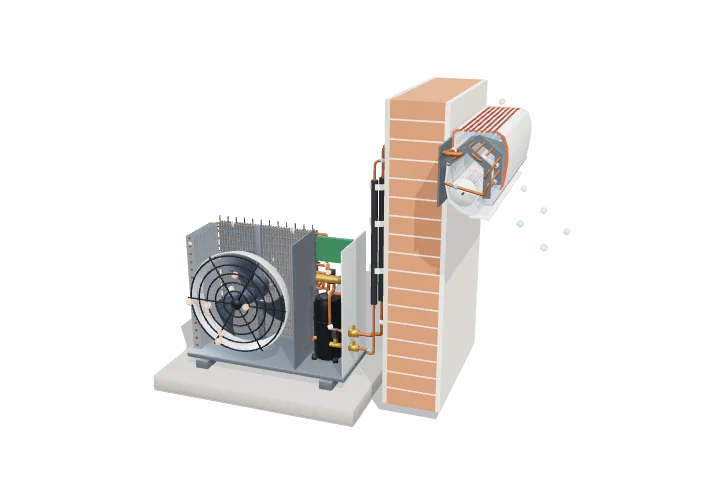
An air conditioner does not make cold — it carries heat from one place to another. A special fluid soaks up heat as it boils in one coil of pipes and gives it out as it turns back to liquid in another coil. Flip a valve and the heat flows the other way, so the same machine can heat the room instead.
A split air conditioner moves heat between a room and the outdoors with a vapour-compression cycle whose compressor, outdoor coil and fan sit outside while an evaporator coil and quiet cross-flow blower sit on the wall indoors. A four-way reversing valve lets the same hardware run backwards as a heat pump, delivering three to four times more heat than the electricity it uses.
Key facts
- Typical capacity
- 2.5–7 kW (≈ 0.7–2 refrigeration tons)
- Refrigerant
- R32 or R410A; ≈ 0.6–1.5 kg charge
- Seasonal efficiency
- SEER ≈ 6–9 (cooling), SCOP ≈ 4–5 (heating, EU ratings)
- Evaporator / condenser
- ≈ 5–12 °C / ≈ 40–50 °C in cooling
- Indoor airflow
- ≈ 500–700 m³/h for a 3.5 kW unit
- Line set
- liquid ¼″ (6.35 mm), gas ⅜″–½″ (9.5–12.7 mm)
Parts you can explore (15)
- Outdoor casing
- Compressor
- Accumulator
- Reversing valve
- Outdoor coil
- Outdoor fan
- Expansion valve
- Indoor casing
- Indoor coil
- Cross-flow blower
- Louvre
- Refrigerant lines
- Wall
- Refrigerant flow
- Airflow
In the 3D model
Rotate and take apart the model, follow a guided tour of what each part does and why it’s needed, change it with a live slider, and test yourself with a short quiz. Free, no sign-up.
Open Split air conditioner in 3D →
OpenArc Models’ models are simplified teaching schematics. Terms · Privacy