Chemistry
Acid–base equilibrium
General chemistry · Equilibrium
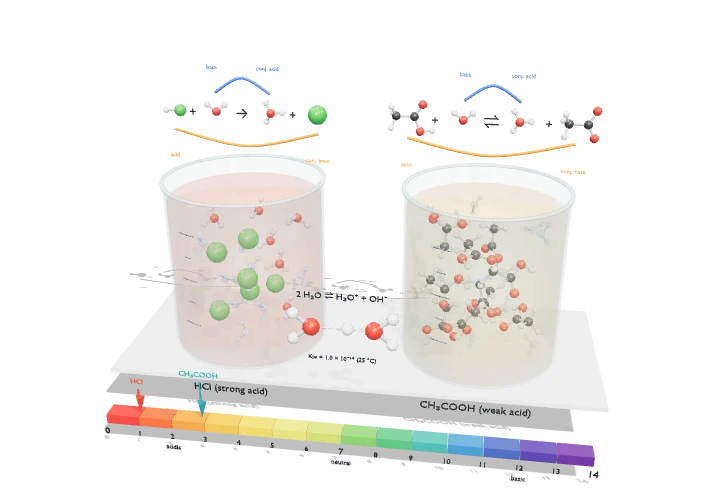 Open the interactive 3D model →
Why is vinegar safe on your chips while the same strength of hydrochloric acid would burn your mouth?
An acid is something that gives away tiny charged particles called protons (H⁺) to water. Hydrochloric acid gives away every single one, but acetic acid — the acid in vinegar — keeps almost all of its protons. The pH number tells you how many protons are loose in the water: the lower the pH, the more acidic.
In water, acids donate protons to H₂O to form hydronium ions: a strong acid such as HCl does this completely, while a weak acid such as acetic acid reaches an equilibrium in which most molecules stay intact. The extent of ionisation is set by the acid dissociation constant Ka, and pH = −log₁₀[H₃O⁺] condenses the result onto a logarithmic scale.
Key facts
- Ka of acetic acid (25 °C)
- 1.8 × 10⁻⁵ mol/L (pKa ≈ 4.74–4.76)
- Kw (25 °C)
- 1.0 × 10⁻¹⁴ mol²/L²
- pH of 0.10 M HCl
- 1.00
- pH of 0.10 M CH₃COOH
- 2.88 (α ≈ 1.3%)
- Neutral pH
- 7.00 at 25 °C; 6.81 at 37 °C
- Ka of HCl
- ≈ 10⁶ (pKa ≈ −6): ionisation effectively complete
Parts you can explore (11)
- HCl beaker
- CH₃COOH beaker
- Hydronium ions
- Chloride ions
- Acetic acid molecules
- Acetate ions
- Water (solvent)
- Water autoionisation
- pH scale
- pH pointers
- Conjugate acid–base pairs
In the 3D model
Rotate and take apart the model, follow a guided tour of what each part does and why it’s needed, change it with a live slider, and test yourself with a short quiz. Free, no sign-up.
Open Acid–base equilibrium in 3D →
OpenArc Models’ models are simplified teaching schematics. Terms · Privacy